)
)
Which US States Send the Most Money Abroad?
)
)
Remittances are more than money—they’re a lifeline that connects families and communities across borders. Every transfer tells a story of care, support, and opportunity.
In the first part of this analysis The most popular destinations to send money from the US, we looked at where money from the US goes, combining transaction data with Google search trends. The findings showed that Mexico, India, and Colombia are the countries that receive the most remittances from the US.
Now, we’re flipping the perspective. Instead of focusing on destinations, this second part looks at where remittances start. Using five years of data and search trends, we explore which US states send the most money abroad—and how those flows connect millions of families around the world.

More Than Money: The Ties That Connect the US to the World
The United States has long been one of the world’s top sources of remittances—not just because of its large migrant population, but because of the deep ties connecting families across borders. These connections have grown over generations and continue to shape how and why money moves around the world.
Migration links between the United States and countries such as Mexico, India, and the Philippines clearly illustrate this.
In Mexico’s case, geographic proximity and cross-border dynamics have created strong family and community networks.
With India, ties deepened especially in the second half of the 20th century, driven by the arrival of professional and business communities, according to the Migration Policy Institute.
The Philippines, meanwhile, maintains a long-standing historical and cultural relationship with the US dating back to the mid-20th century, which has contributed to the establishment of strong, active communities in different parts of the country, as noted by the Pew Research Center.
These ties are not temporary, they are a lasting feature of US migration.

Which US States Send the Most Money Abroad?
Money transfers don’t come evenly from every part of the United States. They’re mostly concentrated in a handful of states that serve as the main hubs for sending money abroad.
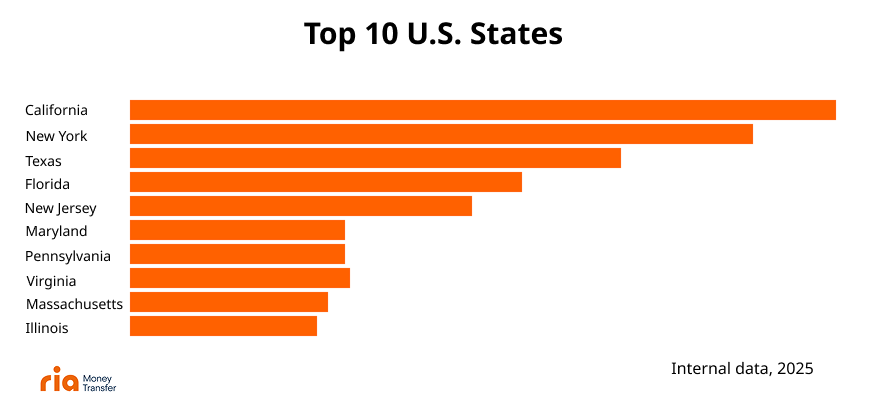
At the top are California, New York, Texas, and Florida. These states stand out because of their large populations and diverse immigrant communities that stay closely connected to family back home.
They’re followed by states in the Northeast and Mid-Atlantic, including New Jersey, Maryland, and Pennsylvania, along with Virginia, Massachusetts, and Illinois, which complete the top ten senders of international transfers.
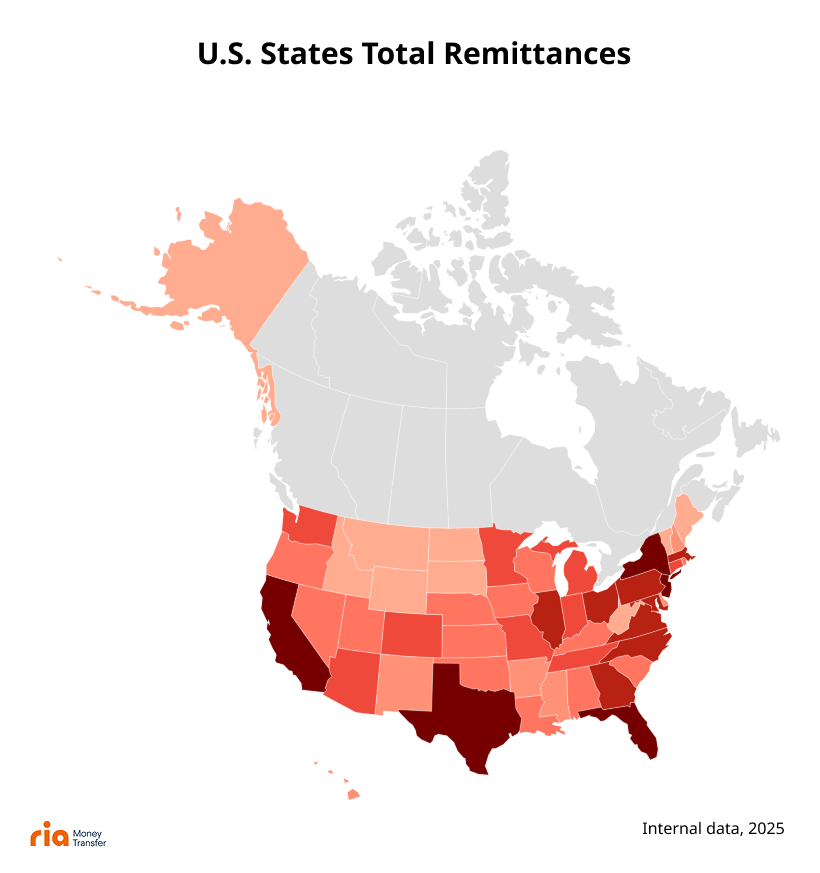
The heat map below makes this pattern easy to see. Most money transfers come from the East and West Coasts, along with parts of the South where migration has long been part of local life.
Per capita intensity
While California, New York, Texas, and Florida send the most money overall, places like the District of Columbia, Rhode Island, New Jersey, and Maryland stand out for how active their residents are in sending money abroad. Their total populations may be smaller, but the amount sent per person is much higher compared to the larger states.
US States Most Interested in Sending Money Abroad
What people search for online doesn’t always match what they actually do later. In our previous study titled The most popular destinations to send money from the US, Mexico, India, and the Philippines came out as the destinations that draw the most attention from US residents looking to send money abroad.
Building on that research, we wanted to see how this online interest is spread across the country. To find out, we analyzed five years of Google Trends data on searches related to sending money to Mexico, India, and the Philippines.

Mexico: The southwest as the epicenter of remittance search interest
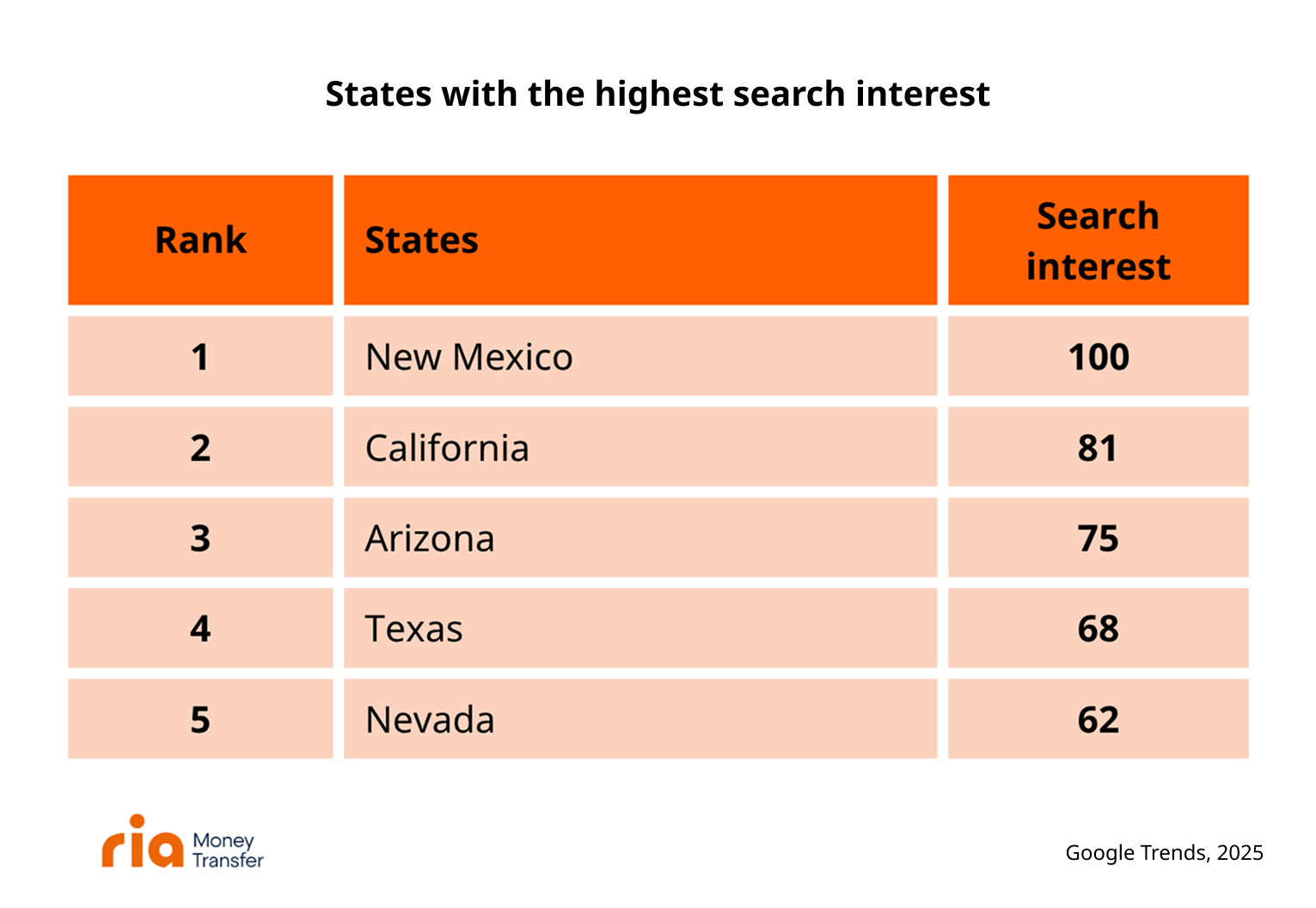
For Mexico, the states with the highest search interest are New Mexico, California, Arizona, Texas, and Nevada. This pattern reflects the strong presence of Mexican communities in these areas, which keeps search activity consistently high.
New Mexico (index 100) leads the list. Its close location to the border and deep cultural ties make it a natural hub for connections to the south. California and Texas also show strong interest, driven by their large populations and long-standing historical ties with Mexico.
India: The northeast leads search interest in transfers
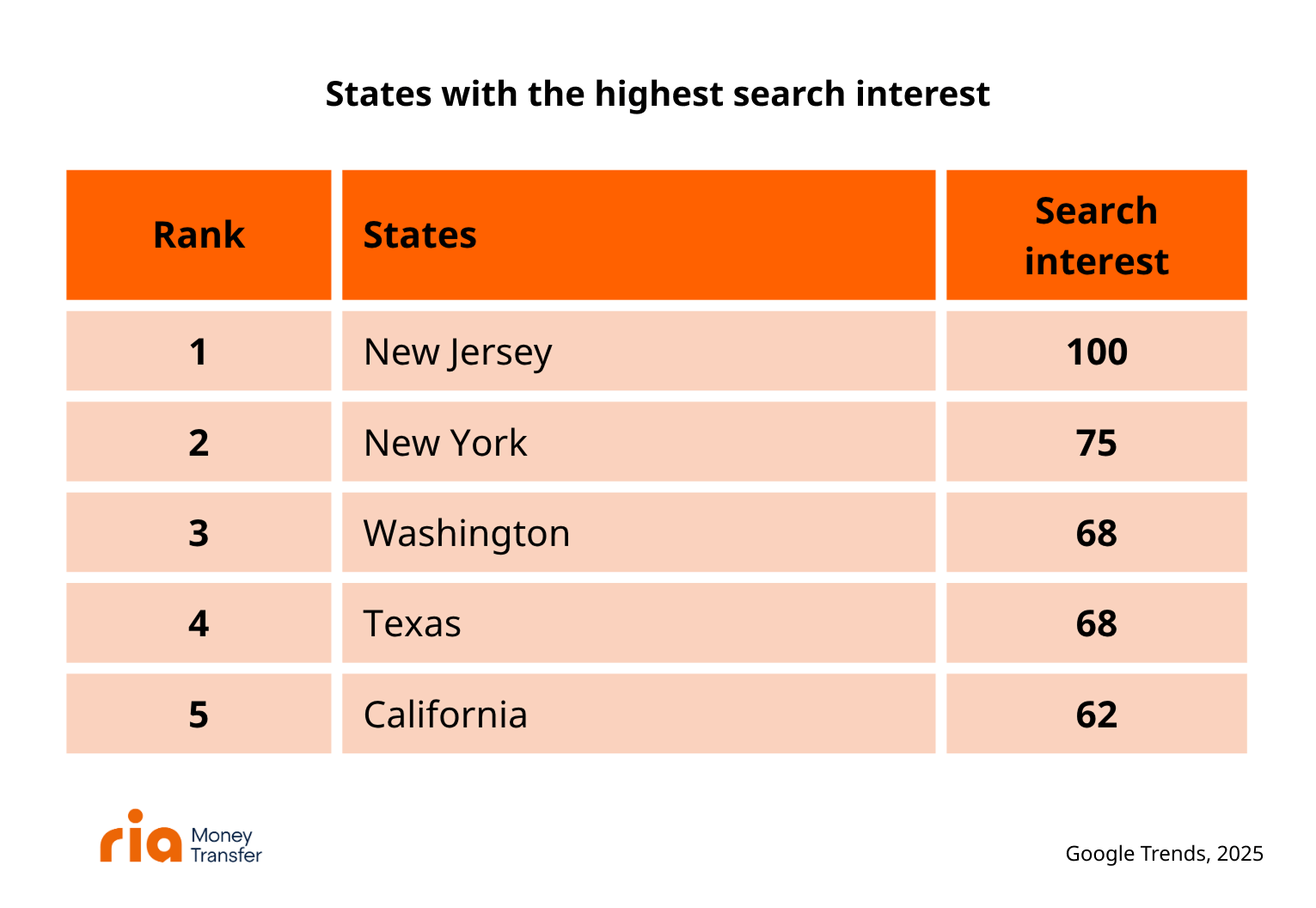
For India, most search activity is concentrated in the Northeast. New Jersey comes in first, followed by New York and Washington. These states have large Indian communities, many of whom work in professional fields like management, science, business and arts, according to the Migration Policy Institute. That strong presence helps explain why interest in sending money to India is especially high in these areas.
The Philippines: The pacific as the main axis of search interest
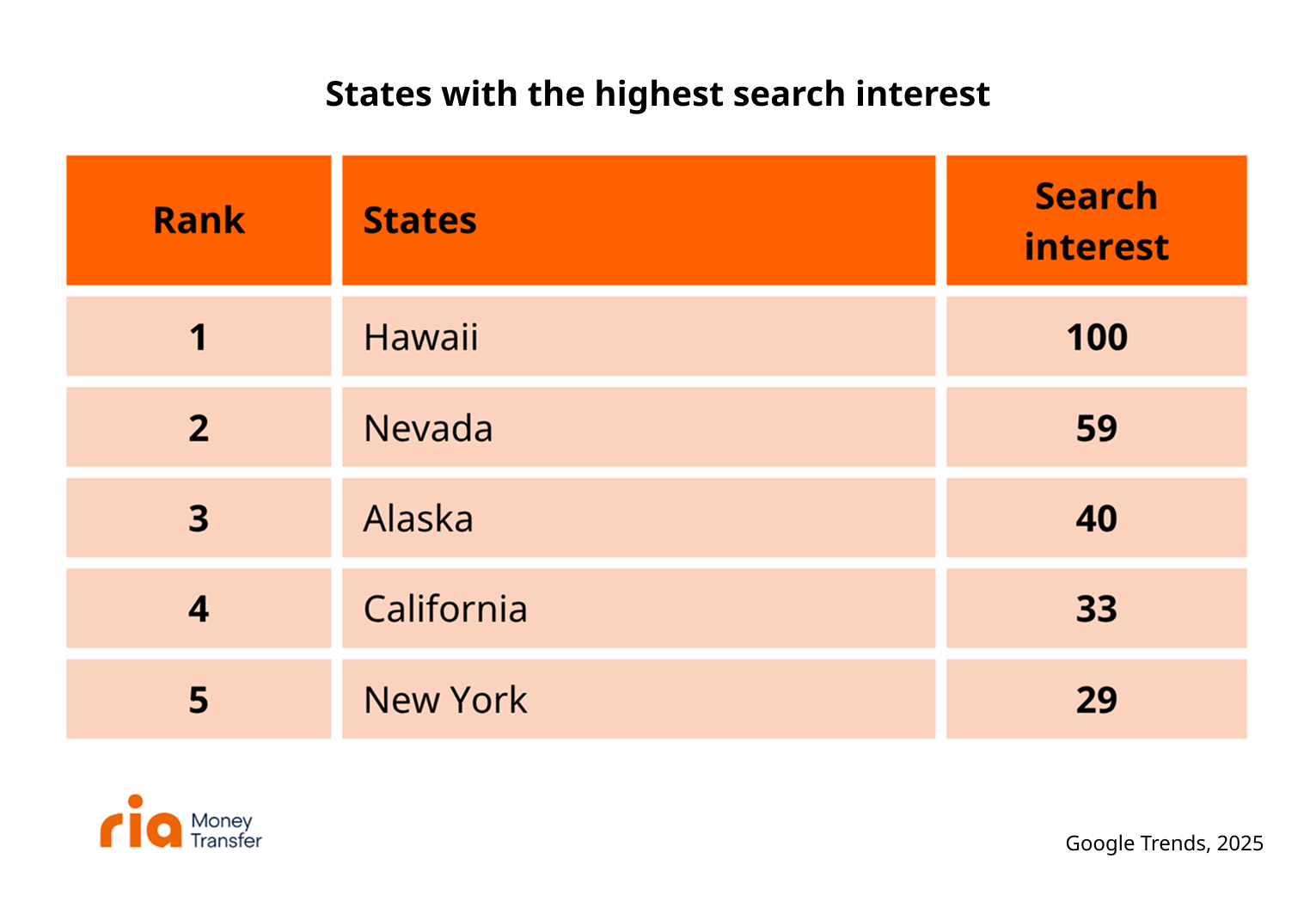
For the Philippines, the strongest activity is found along the Pacific region. Hawaii ranks first by a wide margin, followed by Nevada, Alaska, California, and New York. This pattern reflects the long history of Filipino migration to Hawaii and California, where established communities continue to play an important role in supporting families back home.
Three countries, three migration stories: A comparative view
To understand the real dynamics of money transfer flows within the United States, it is useful to look at these searches in a single visualization. What we see when doing this is a surprisingly stark geographic divide:
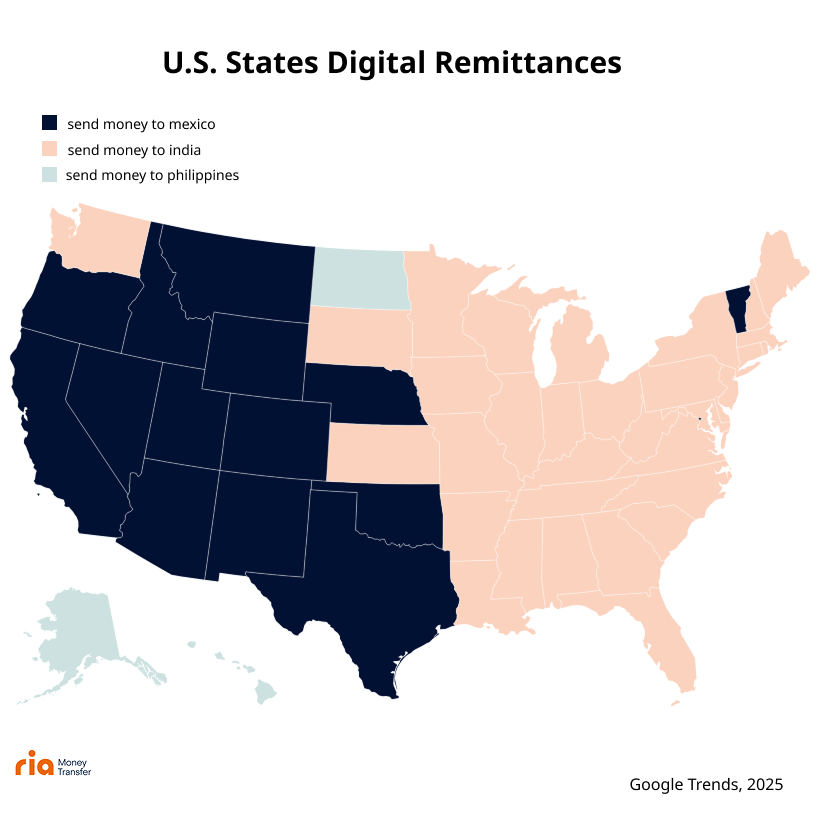
In the West, search interest is dominated by transfers to Mexico.
In the East, the concentration shifts toward India.
Meanwhile, the Philippines remains centered in the Pacific region, with Hawaii as its main hub.
This contrast shows that online interest in sending money abroad looks very different from one region to another, revealing three distinct patterns that exist side by side across the country.
Actual transactions vs. Online searches
Rather than just looking at total volumes, which naturally put the biggest states on top, we wanted to understand how much each destination is represented within each state’s transfers. This helps show the level of engagement people have in sending money to Mexico, India, and the Philippines.
We then compared real transaction data with online search interest to see where the two align and where they differ. This comparison helps reveal the gap between what people look up online and what ultimately turns into an actual transfer.
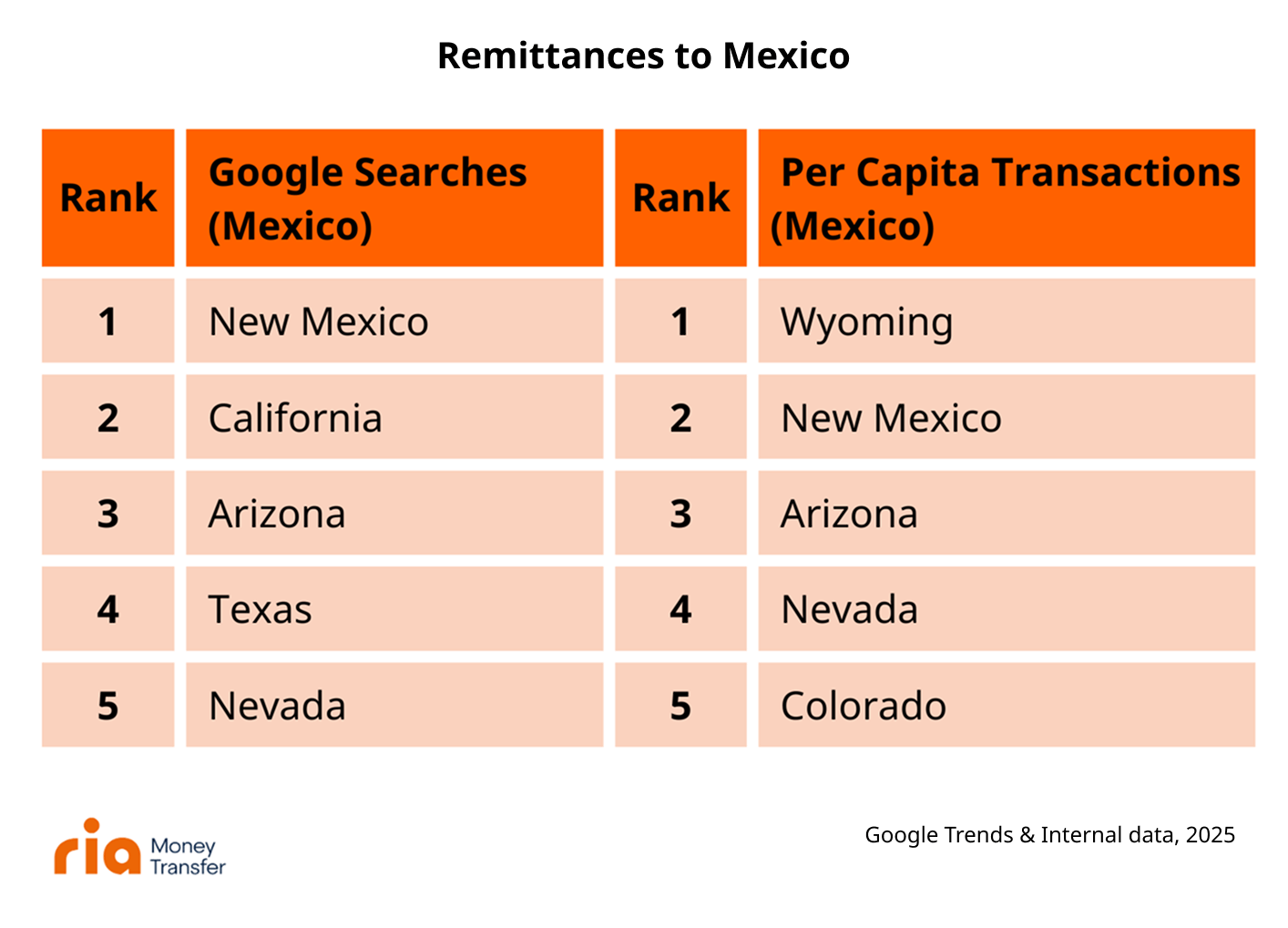
Search data shows New Mexico at the top, followed by California, Arizona, Texas, and Nevada. But when we look at actual transaction share, the picture changes. Wyoming moves into first place, ahead of New Mexico, Arizona, Nevada, and Colorado.
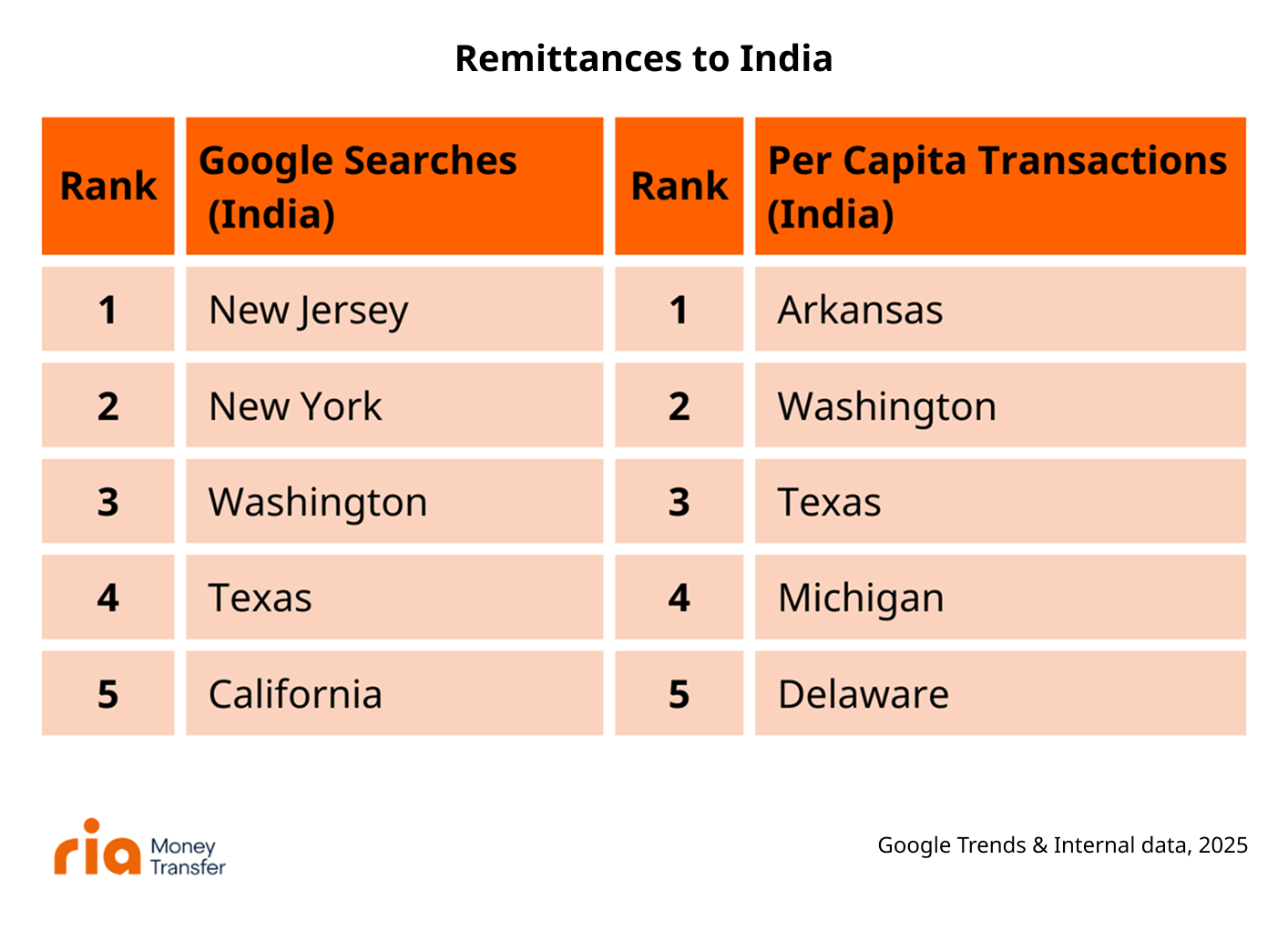
For India, most search interest comes from the Northeast, especially New Jersey, New York, and Washington. But when we look at real transaction share, the focus shifts to Arkansas, Washington, followed by Texas, Michigan, and Delaware.
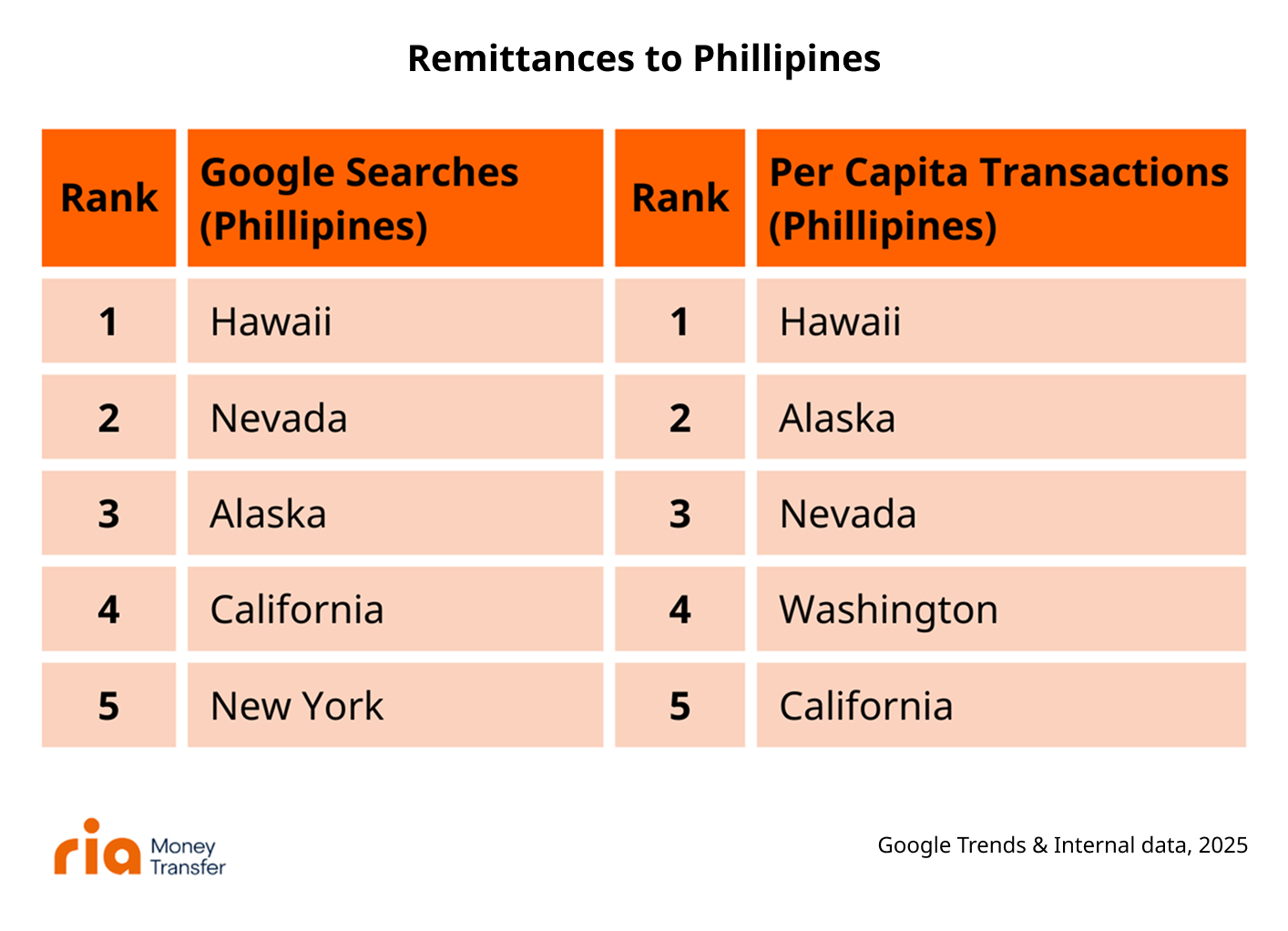
For the Philippines, Hawaii leads the search rankings, followed by Nevada, Alaska, California, and New York. But the real transaction data tell a different story. While Hawaii remains in first place on both lists, Alaska moves up to second when it comes to actual purchases, followed by Nevada, Washington, and California.
This contrast shows that online search interest doesn’t always match real-world behavior. Google Trends reflects curiosity and intent, while actual money transfers are driven more by established Filipino communities and long-standing networks that have been sending funds for years.
State–Country / Country–State Corridors
Money transfers aren’t spread evenly around the world. They move through a few key corridors that have developed over time. These routes reflect long-standing migration patterns, strong community ties, and ongoing economic needs on both sides of the border.
State–Country Corridors
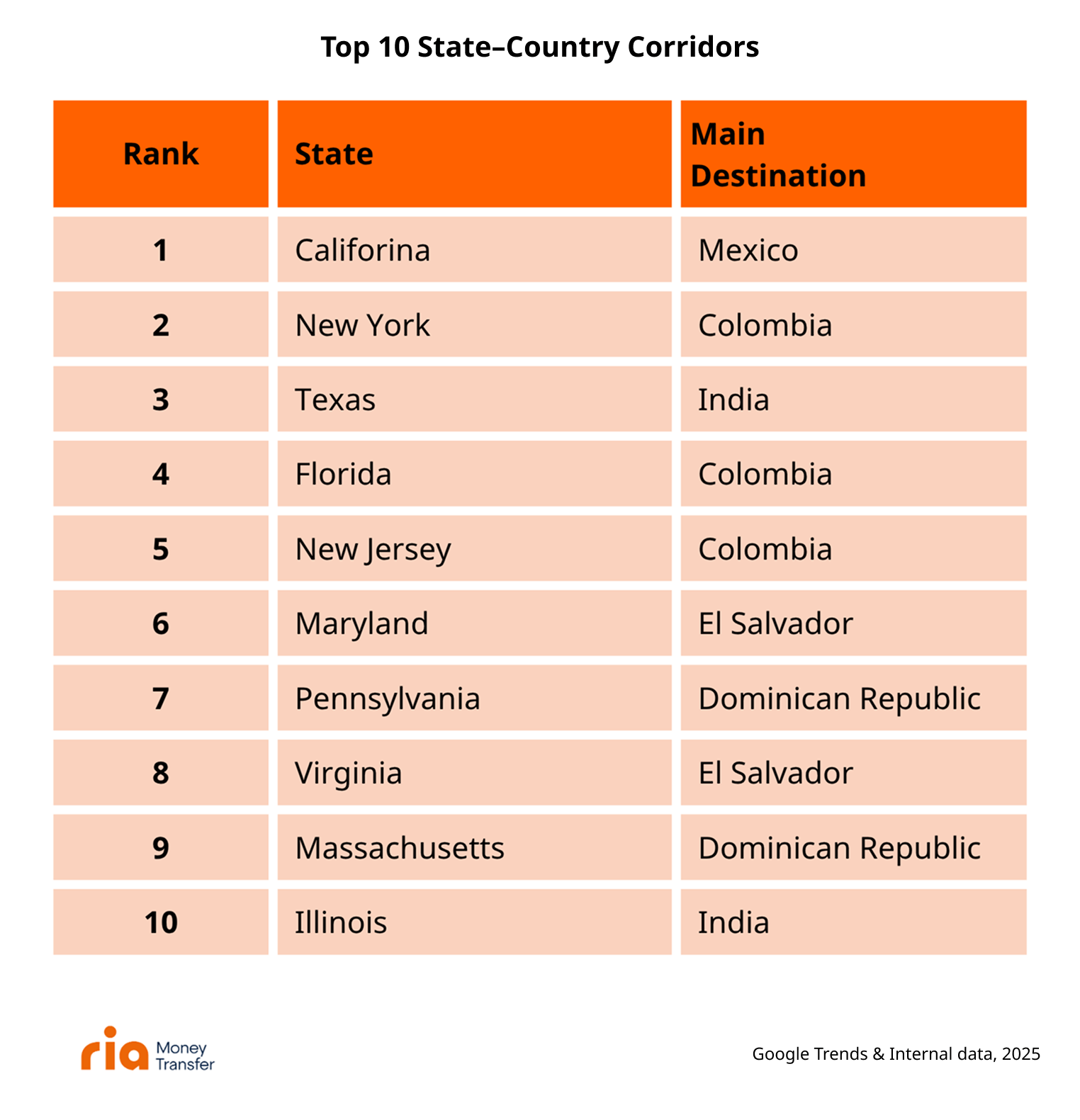
Using transaction data from the past year, we identified the ten most active money transfer routes. The table below shows the main state-to-country connections, highlighting where most of each state’s transfers are sent.
California–Mexico: The Largest Corridor
The largest corridor is California to Mexico, which makes up a major share of all transfers to Latin America. Its size reflects the deep historical, cultural, and social ties that link the two.
New York and Florida with Colombia
On the East Coast, the New York to Colombia corridor stands out, supported by the large Colombian community in the greater New York area. Florida shows a similar trend, with a significant share of transfers also going to Colombia. Together, these flows make Colombia one of the main destinations for money sent from the United States.
Texas and Illinois with India
Another key corridor is Texas to India, reflecting the growing Indian community in the state and its strong presence in major industries. Illinois follows a similar pattern, with a large portion of its transfers also directed to India.
Other key corridors
The analysis also points to several other strong connections, including New Jersey with Colombia, Maryland and Virginia with El Salvador, and Massachusetts and Pennsylvania with the Dominican Republic.
Each of these connections shows how the places where migrant communities settle shape unique money transfer patterns. For many families separated by distance, these flows remain a crucial source of support and stability.
Country – States corridors
Looking at the data from the opposite angle, identifying which US states send the most money to each destination, reveals some clear patterns.
This section focuses on Mexico, Colombia, India, El Salvador, and the Dominican Republic. These countries appeared as the top destinations in the previous table and serve as the best examples to illustrate how these flows are distributed.
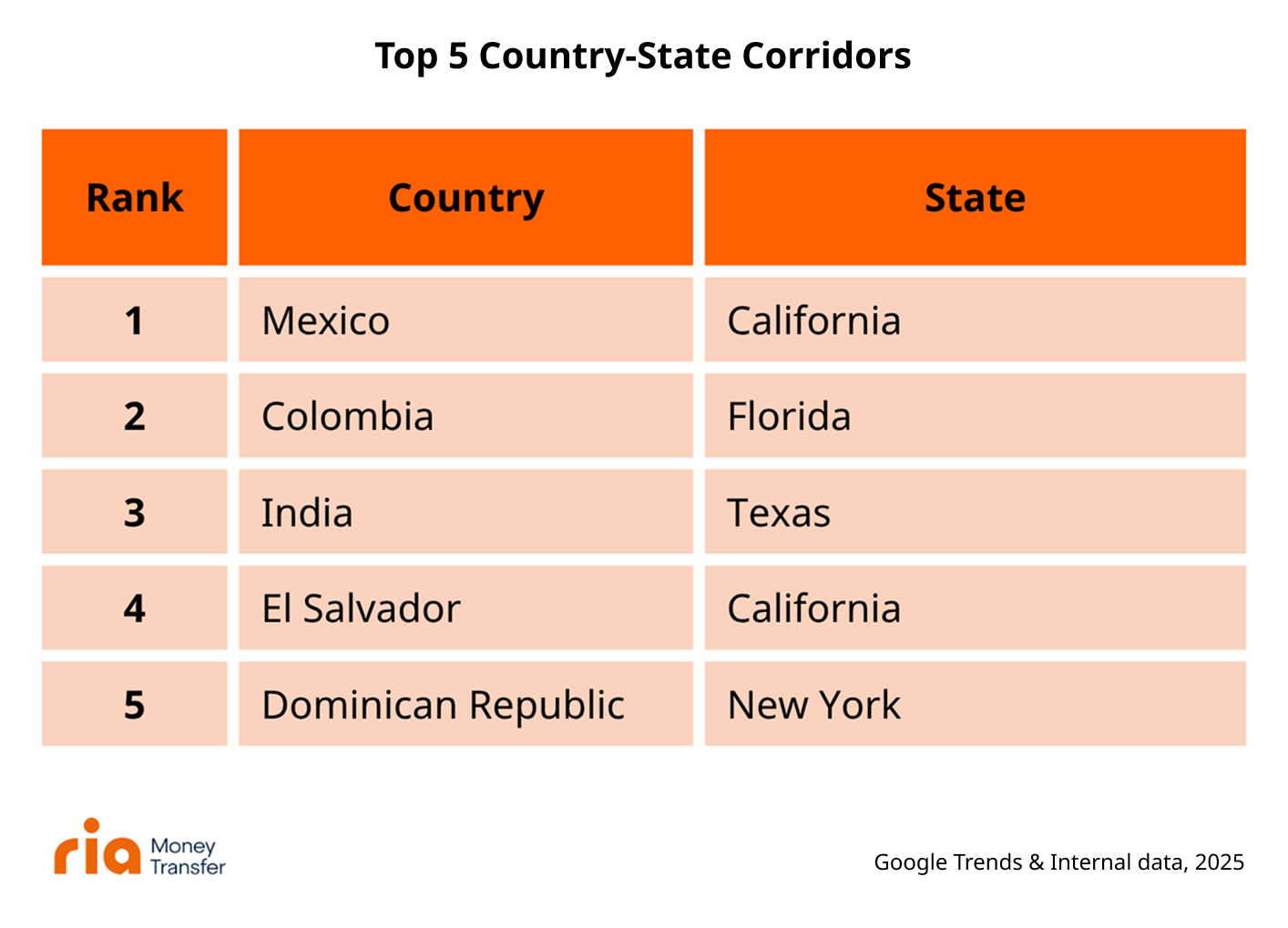
Mexico – California: Mexico receives the largest amount (absolute volume) of money from California, making this the single most significant corridor overall.
Colombia – Florida: Most of Colombia’s transfers come from Florida, which stands as its main source of funds from the United States.
India – Texas: For India, the strongest flow originates in Texas, which remains the leading state for money transfers to the country.
El Salvador – California: Most of El Salvador’s transfers come from California, reflecting the deep roots of the Salvadoran community there.
Dominican Republic – New York: The Dominican Republic receives the largest share of its transfers from New York, a long-standing corridor that continues to drive support for families in the Caribbean.
Together, these corridors show how a small number of states account for most of the money sent abroad. California, Florida, Texas, and New York serve as the main hubs linking the United States with the rest of the world’s migrant and financial networks.
Send Money with Ria
Most money transfers from the US come from just a handful of states—led by California, New York, Texas, and Florida. These flows reflect deep community ties built over generations, not random patterns on a map.
Interestingly, online searches don’t always match real transfers. While people in different regions search most for destinations like Mexico, India, or the Philippines, the actual corridors often tell another story.
Together, digital and transaction data show how remittances connect families and economies across borders—one transfer at a time.
Wherever your loved ones are, send money with Ria—fast, secure, and made to keep you connected.
About the author

Gabriela Solis
Gabriela Solis is Ria's Senior Content Writer. Located in Querétaro, México, she focuses on telling stories that show the myriad human faces of remittances.
Related posts
Why Migrants Send Money: The Emotional Side of Remittances
Sending money home is about more than financial support. Explore the pride, love, responsibility and pressure behind remittances and what they mean for migrants.

How to send money on WhatsApp with Ria: Your complete guide
Everything you need to send money with Ria on WhatsApp: what to have ready, transfer limits, payment, delivery options and how the chat works from start to finish.

What is Bre-B and how does it work?
Bre-B is Colombia's instant payment system. Learn how llaves work, what Bre-B costs, its transfer limits, and how to send money to a Bre-B key from abroad with Ria.

The Money That Moves the World Is Personal
200 million people built one of the world's most powerful financial systems, but few call it that.