)
)
Top destinations to send money from the US
)
)
Sending money across borders is much more than a financial transaction. It’s how families stay connected. It’s how millions of people show care, support, and stability across the globe.
It’s also the heart of Ria. Because of that, we took a closer look at money transfers through a new lens. Instead of focusing only on the amount sent, we compared two distinct data sets: Google searches, which show digital trends, and real transaction data, which reveals how people actually send and spend their money.
The result is a clear view of global remittances: where Americans send money most, and what these trends tell us about the people behind each transfer.

Global importance of money transfers
Money transfers home has become a cornerstone of the global economy. These rise and fall with the job and economic conditions in the countries where people live and work. That connection means local shifts in employment or income don’t just affect individuals abroad. They ripple across borders into the daily lives of families and communities back home.
The weight of these transfers is now undeniable. According to the World Bank, money going to emerging economies has already surpassed both foreign direct investment and official development aid. The Federal Reserve also notes that this money has become one of the important sources of external financing for developing nations, making it central to their economic stability.
Geographic distribution of flows
The United States is the largest sources of money sent abroad each year. This comes from the size of its economy and the wealth and diversity of its migrant communities, who keep strong ties with their home countries, according to the International Organization for Migration.
Money sent from the United States now reaches families in nearly every part of the world. While much of it goes to Latin America and the Caribbean, significant amounts also flow to Asia, Africa, and Europe.
These transfers don’t just cross borders—they connect people and support everyday life, from groceries and rent to education and small businesses.
So where does most of this money actually go? Which countries receive the largest share, and what causes these numbers to rise or fall? Let’s take a closer look.
The Most Googled Destinations for “Sending Money”
Before sending money online, most people do one thing first: Google it. They compare options, research fees, and choose the provider that feels right for their transfer.
With this in mind, Ria looked at the top Google searches for “send money to [country]”, to see where most people are most often looking to send money from the US. Take a look at the top twenty destinations:
Asia clearly leads the way, making up nearly half of the countries ranked and about 47% of all searches. The Americas come next, with four countries that together account for roughly 30% of the total. Africa and Europe play smaller but still meaningful roles, while Oceania makes an appearance only once, with Australia.
Evolution of remittance interest: Mexico, India, and the Philippines
Among all the destinations we looked at, three countries stand above the rest: Mexico, India, and the Philippines. These countries by far account for the largest share of Google searches related to sending money from the United States.
Taking it one step further, we turned to Google Trends data to see how interest in sending money from the US to Mexico, India, and the Philippines has changed over the past 20 years:
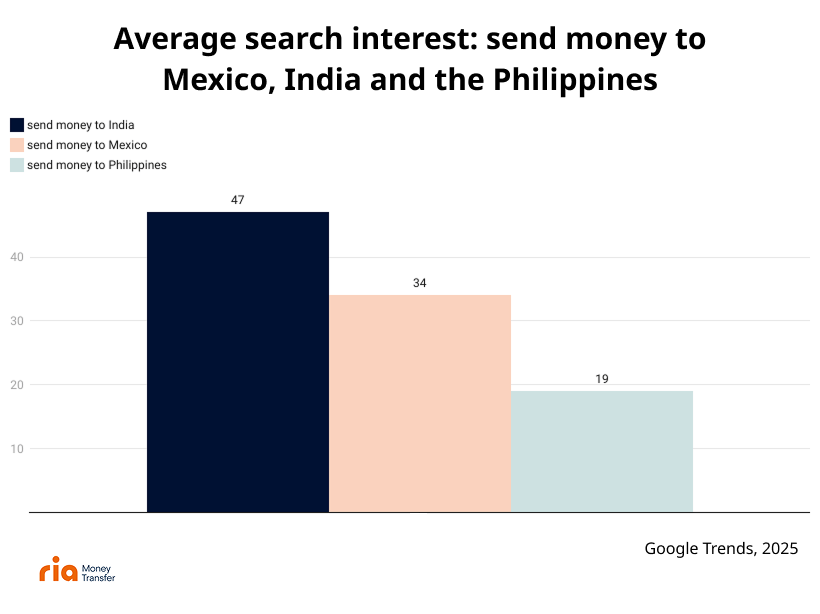
India leads the ranking with 47 points on the Google Trends index.
Mexico follows with 34 points.
And last, the Philippines has 19 points.
According to Google Trends, the scores shown (47, 34, and 19 points) represent relative search interest on a scale from 0 to 100, where 100 marks the peak popularity of a term over the selected period. This means that India generated the highest search activity compared with Mexico and the Philippines over the past two decades.
Search interest over the past 20 years
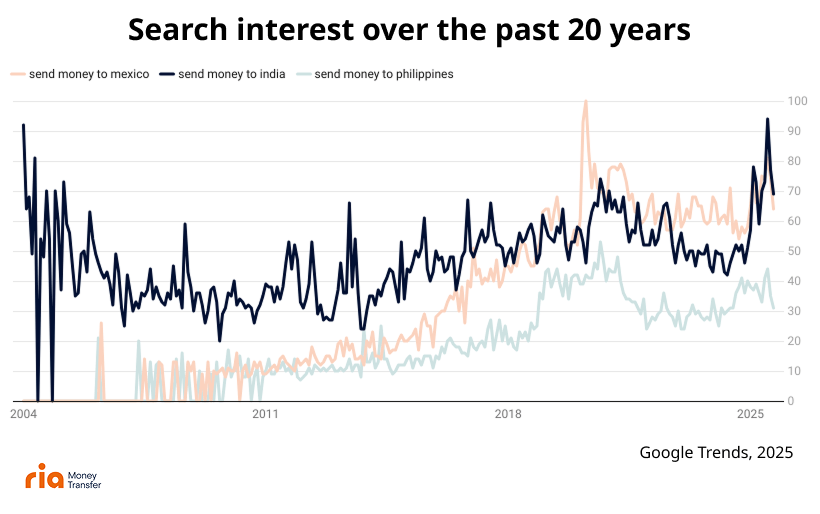
Over the past 20 years, search interest has shifted a lot. In the mid-2000s, India dominated search interest, while Mexico and the Philippines barely registered. But around 2010, both countries started climbing steadily — and Mexico’s rise has been especially impressive. Today, it stands shoulder to shoulder with India as one of the top destinations US senders search for.
Top receiving destinations based on actual transactions
We’ve seen where people in the US most often search to send money, but online searches don’t always reflect reality. What people plan or explore on Google can look very different from how money actually moves across borders.
That’s why we turned to real transaction data to ask: which countries receive the most money transfers from the US? Looking at transactions from the past year, Ria identified which countries truly receive the most remittances from the United States:
The data shows that money transfers from the US are concentrated in just a few countries. Mexico leads the way, followed closely by India and Colombia. Together, these three destinations account for more than one-third of the studied remittances sent from the US.
Actual transactions vs Internet searches
We’ve now seen how remittance destinations show up online versus in real life. But how closely do search trends align with actual transfers? Let’s compare how Google search interest with Ria’s transaction data from the past year.
Comparative table: Actual transactions vs Google Searches
To illustrate this point, the following table compares the countries most searched on Google and those that actually receive the largest share of money transfers from the United States.
At the top of the list, there is a clear overlap: Mexico and India lead both in transaction volume and in digital searches. This indicates the strong presence of these communities in the United States and the desire to maintain a steady flow of remittances to their countries of origin.
From the third position onward, however, significant differences emerge. Colombia ranks among the top destinations in actual money transfers, yet falls much lower in searches, around eleventh place. In contrast, the Philippines shows the opposite pattern: it is the third most searched country on Google, despite ranking only eleventh in transaction volume.
This mismatch highlights a particular behavior within the Filipino community: although they do not send as much in absolute terms, they show strong digital engagement in exploring, comparing, and optimizing their sending options.
Seasonal patterns
Money transfers tend to follow a yearly rhythm, with clear peaks and dips that reflect both financial needs and cultural traditions among migrant communities in the US.
As the chart below shows, transfers present their lowest point of the year in the third quarter (Q3 2024) before rising to their highest level in the second quarter (Q2 2025).
At Ria Money Transfer, we set out to see how holidays and major events might shape the flow of money being sent home, looking for patterns and possible connections in the data.
A few key observations can be made from reviewing this data.
Third Quarter 2024 (Q3: July – September)
The third quarter is the slowest time of year for money being sent home.
One key event during this time is Eid al-Adha, a major holiday in countries like Pakistan, Afghanistan, and Bangladesh. Transfer volume jumps here as migrants are possibly sending money home to help families prepare special meals, support relatives and neighbors, and take part in long-standing traditions.
This quarter also lines up with the start of the school year in many places. Parents abroad often send extra to cover tuition, uniforms, books, and supplies for their children.
Fourth Quarter 2024 (Q4: October – December)
As the year comes to a close, money sent home tends to climb again, largely tied to global and regional celebrations.
In India, Diwali creates a rise in transfers as families spend on gifts and family gatherings.
The Christmas and New Year season drives the biggest wave. During this time, people send money for presents and holiday meals.
Whether it is a holiday, a celebration, or school expenses, the data shows how sending money home goes beyond economics. It is how people stay connected and support the people they love, even if they are thousands of miles away.

First Quarter 2025 (Q1: January – March)
In the first few months of the year, there’s often a spike in transfer activity, likely tied to major cultural celebrations. One in particular is The Chinese New Year, especially for Filipino communities and other individuals with strong ties to China.
Second Quarter 2025 (Q2: April – June)
In the second quarter, we see an even larger spike —likely driven by several major celebrations and family events that take place during these months.
The first is Mother’s Day. No matter the culture, mothers are celebrated, and when people send money home during this time, it’s not just about giving a gift, it’s a way of showing up for the family even if they can’t be there in person. It’s a way of saying thank you, or to show love and support.
The next Q2 spike coincides with Holy Week in Catholic-majority countries such as Colombia, El Salvador, Peru, and the Philippines. Celebrations during this week often require travel, family gatherings, and special expenses, which could lead to more money being sent home to help cover the costs.
This quarter also lines up with the end of the school year in many countries. Families often send extra money to help with graduation costs, school trips, or to get ready for fees for the next academic year.
Send Money with Ria
Our data shows that money transfers are about much more than numbers—they tell stories of connection, care, and culture. For millions of migrants, sending money home is both practical and personal.
We saw strong links between online interest and real transfers to major destinations like Mexico and India, but also some surprises—like high search activity for the Philippines and strong transfer volumes to Colombia. It’s a reminder that behind every transfer is a mix of needs, moments, and meaning.
At Ria, we study these trends to better serve the people who keep the world connected. Wherever your loved ones are, send money with Ria—quick, secure, and made for you.
About the author

Gabriela Solis
Gabriela Solis is Ria's Senior Content Writer. Located in Querétaro, México, she focuses on telling stories that show the myriad human faces of remittances.
Related posts

The Money That Moves the World Is Personal
200 million people built one of the world's most powerful financial systems, but few call it that.
Colombia Earthquake (2026): How to Help, Find Relief Resources, and Send Money
On the morning of August 10th, a 7.4-magnitude earthquake struck western Colombia. Ria is waiving transfer fees to Colombia through August 16.
Venezuela Earthquake (2026): How to Help, Find Relief Resources, and Send Money
Many of our customers have loved ones in Venezuela. If that's you, we're thinking of you. Here's what you need to know: Information is based on updates from USGS, UN OCHA, IFRC, and other humanitarian organizations. Details may change as emergency response efforts continue. On the evening of June 24, two powerful earthquakes struck Venezuela.
The Currency of Caring: The Human Side of Remittances
Every year on June 16th, the world observes International Day of Family Remittances. On that date, we recognize the millions of migrants who send money back home to support their loved ones, helping build a better future for countless households across the globe. Although there is a lot of data about the financial impact and []