)
)
A Brief History of Remittances and Immigration in Colombia
Last updated: August 2024
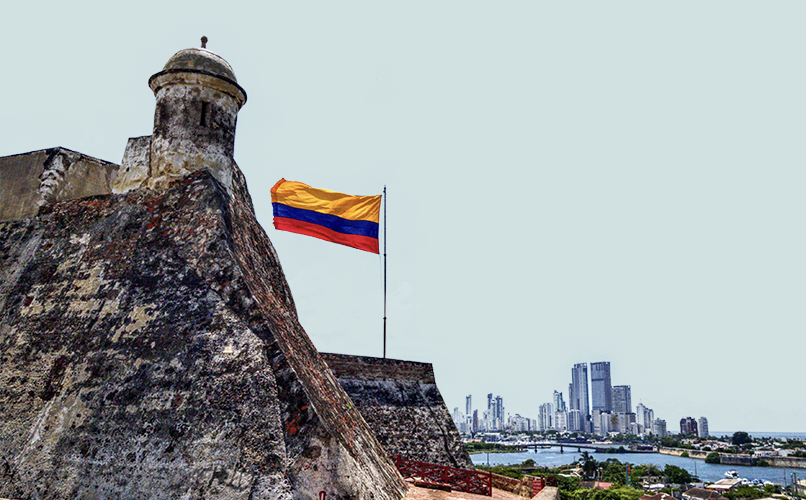
Colombia, the land of magic realism and the second most populated country in South America, has always had a close relationship with its neighbors. Since the era of Gran Colombia, the brainchild of political leader Simón Bolívar, the borders of what is today the Republic of Colombia have witnessed the comings and goings of many migrants, with significant amounts of remittances sent to and from the country.
Let’s take a closer look.
A (Very) Brief History of Colombia
According to archeological research, the territory of present day Colombia has been occupied since at least 12,000 BCE by Indigenous civilizations. Over time, these early settlements established themselves into structured societies that cultivated the land and developed their own political systems. Among these nations were the Quimbaya, the Zenú, and the Muisca, to name a few. It is also known that, before the arrival of the Europeans, the Muisca formed a Confederation of rulers among themselves, which demonstrates just how complex pre-Columbian societies were.
After the arrival of the Spanish, the New Kingdom of Granada was founded, and thus began the establishment of different land properties such as the encomiendas. Later, in the 18th century, this political entity and its provinces were reorganized into the Viceroyalty of New Granada. During this period, Bogota became the capital and an important administrative center of the Spanish crown. In 1810, the Viceroyalty achieved independence from the Spanish empire, developing into a country known as the United Provinces of New Granada. From there, further political developments brought the country under a short-lived Granadine Confederation, the United States of Colombia, and finally the Republic of Colombia, founded in 1886.
Since then, Colombia, a country with unique landscapes from its islands to the Amazon rainforest, has experienced complex political, economic and social changes to transform into one of Latin America’s strongest economies. With the Colombian peso as its currency, the country has also become an important leader in the region, playing a prominent role in the Organization of American States (OAS) and acting as the North Atlantic Treaty Organization’s sole partner in Latin America.
Colombian Immigration
The economy of Colombia is increasingly diversifying, has strong internal demand, and has grown by more than 2% in nineteen of the last 24 years. Even so, the country has been subject to migration waves, with many Colombians choosing to live abroad. The Colombian Ministry of Foreign Affairs distinguishes three migration waves in Colombia’s history, the first taking place in the 1960s with the United States as the primary destination, the second in the 1980s to Venezuela, and the third in the 1990s to Spain.
The first wave was led by middle- and upper-class migrants who, with a strong command of the English language, were increasingly looking for job opportunities overseas. Today, around 1.6 million Colombians reside in the United States.
Given Colombia is the third largest coffee producer and the second largest cut flowers exporter in the world, as well as the fourth largest oil producer in Latin America, its industry also spurs immigration from neighboring countries, China and Japan.
While more than 721,000 Colombians had moved to Venezuela by 2011, the recent socio-economic crisis has led many to return, bringing with them an unprecedented wave of Venezuelans looking for a fresh start. Colombia currently hosts more migrants from Venezuela than any other country, around 2.8 million.
On the other hand, migration toward Spain was led by middle- and working-class women from Eje Cafetero, a diaspora which peaked in 1998. Currently, more than 550,000 Colombians live in Spain, making it the third largest foreign population in the Iberian country. However, many nationalized and native Spaniards have also moved to Colombia, totaling 44,925 according to INE (Instituto Nacional de Estadísticas, National Statistics Institute).
The impact of Colombian remittances
In 2023, Colombian migrants sent home more than US$ 10 billion. Despite the fact this only represents around 2.8% of the country’s GDP, Colombia is the fourth highest recipient of remittances in Latin America, according to World Bank Data. During the same period, migrant workers in Colombia sent US$ 433 million abroad.
Colombia is both an important sender and receiver of international money transfers. The steady flow of remittances form part of a critical ecosystem whereby funds reach those who need it most, both at home and abroad.
Ready to send money to Colombia with Ria? Download our app for iOS or Android today to get started!
This is an installment of our “Brief Histories” Series. Continue discovering: Poland, Senegal, Malaysia, Philippines, Canada, Italy, Georgia, Dominican Republic, Morocco and Ukraine.
About the author

Gabrielle van Welie
Gabrielle van Welie is Ria's Global Content Manager. Originally from Dominican Republic, she specializes in the cultural impact of remittances and migration across the globe.
Related posts

The Currency of Caring: The Human Side of Remittances
Every year on June 16th, the world observes International Day of Family Remittances. On that date, we recognize the millions of migrants who send money back home to support their loved ones, helping build a better future for countless households across the globe. Although there is a lot of data about the financial impact and […]

How Mobile Wallets Are Expanding Financial Inclusion in Emerging Markets
In the last decade, there has been a surge of applications and services that enable people to store, send, and receive money without needing a traditional bank account. Digital financial services such as mobile wallets have emerged as an accessible option for millions of unbanked people. These alternatives have become the first point of access […]
Sadio Mané and Ria: Empowering the Global Diaspora
Sadio Mané is considered one of the best and most recognizable African footballers of all time. But the Senegalese striker is more than just a global football icon: throughout his career, he’s reinvested his earnings back into his community, bridging the gap between football, migration and financial empowerment. That’s why at Ria we are extremely […]

How to Build a Monthly Money-Sending Routine
When your loved ones receive the money you send each month, it brings peace of mind on both sides: they can cover everyday needs, and you know your hard-earned money is making a real difference. But without a plan, it can slip into last-minute stress, surprise costs, or missed transfers altogether. The good news? With a simple routine, […]