)
)
Why Are Currency Exchange Rates So Volatile?
)
)
Imagine planning a dream vacation abroad, only to find that the cost has skyrocketed overnight due to a sudden shift in the exchange rate. Or think about a multinational company that must navigate the turbulent waters of currency markets to protect its profits. These are just glimpses of how currency exchange rate volatility affects our lives.
But what causes these dramatic swings in currency values? Why do currency exchange rates change so frequently and sometimes unpredictably? Keep reading to learn about the key factors that drive these fluctuations.
What are Currency Exchange Rates?
Currency exchange rates are the rates at which one currency can be exchanged for another. They are the price of one currency in terms of another currency.
For example, if the exchange rate between the US Dollar (USD) and the Mexican Peso (MXN) is 18.44, 1 USD can be exchanged for 18.44 MXN.
There are primarily two types of currency exchange rate systems:
Fixed Exchange Rates
Under a fixed exchange rate system, a country’s currency value is tied to another major currency, such as the US Dollar or gold.
The government or central bank commits to maintaining the currency’s value within a narrow band around a specified rate.
This system aims to provide stability in international prices and reduce uncertainty in trade and investment.
Floating Exchange Rates
In a floating exchange rate system, the value of a currency is determined by market forces without direct government or central bank intervention.
The exchange rate fluctuates based on supply and demand conditions in the foreign exchange market.
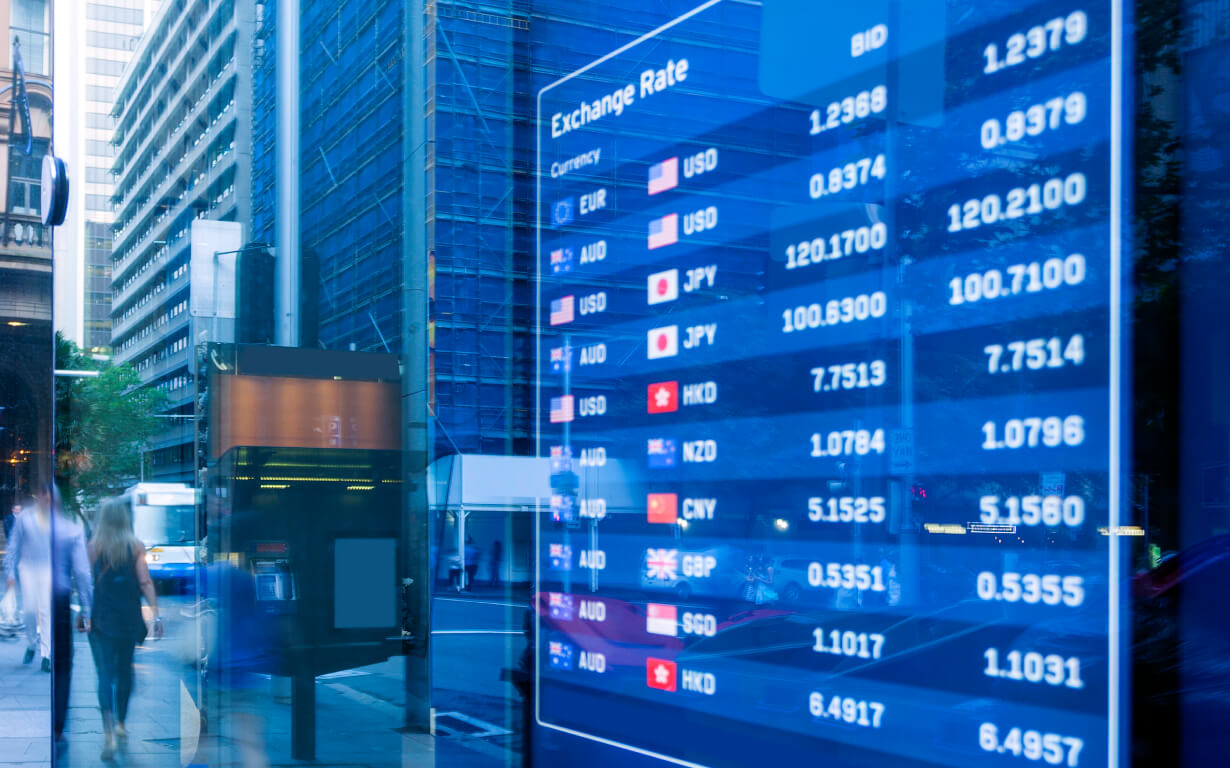
How Are Exchange Rates Determined?
Exchange rates are fundamentally determined by the forces of supply and demand in the foreign exchange (forex) market. This global marketplace operates 24/7 and involves the buying, selling, and exchanging of currencies at current or determined prices.
Here are some of the key factors that influence currency exchange rates:
Supply and Demand Dynamics
When the demand for a country’s goods, services, or financial assets increases, so does the demand for its currency. For example, if American investors are keen to invest in the Eurozone, they need Euros to buy European stocks or bonds. This increased demand for Euros will cause the Euro to appreciate against the US Dollar.
Conversely, if there is a high supply of a currency, its value will tend to fall. For example, if a country imports more than it exports, it will need to sell more of its currency to buy foreign currencies to pay for its imports, increasing the supply of its currency on the forex market.
The interaction of supply and demand determines the equilibrium exchange rate. This equilibrium constantly shifts due to various economic, political, and market factors, such as the following:
Interest Rates: Increasing interest rates make lending more profitable for investors, encouraging foreign capital to flow into the economy. Higher demand for the currency leads to appreciation.
Economic Indicators: Indicators like GDP growth, unemployment rates, and manufacturing output can influence investor confidence and affect currency demand.
Political Stability and Economic Performance: Countries with stable political environments and robust economic performance tend to attract foreign investment, increasing currency demand.
Speculation: Traders and investors’ expectations about future currency movements can drive demand or supply. For example, if speculators believe a currency will strengthen, they will buy more of it, driving up its value.
Role of Central Banks and Government Policies
Central banks and government policies play a critical role in shaping exchange rates. Their actions can directly or indirectly influence the supply and demand for their currency.
Central Bank Interventions
Monetary Policy: Central banks use monetary policy to influence exchange rates. By adjusting interest rates, they can control the flow of money. For example, raising interest rates can attract foreign capital, increasing demand for the currency and causing it to appreciate.
Open Market Operations: Central banks can buy or sell government securities in the open market to influence money supply and liquidity. These operations can impact exchange rates by altering the supply of the currency.
Foreign Exchange Reserves: Central banks hold reserves of foreign currencies and gold. By buying or selling their currency on the forex market, they can stabilize or influence the exchange rate. For example, to prevent a currency from depreciating too much, a central bank might sell its foreign currency reserves to buy its own currency, increasing demand for it.
Government Policies
Fiscal Policy: Government spending and taxation influence economic activity, affecting exchange rates. For example, expansionary fiscal policy (increased government spending or tax cuts) can stimulate economic growth, attracting foreign investment and strengthening the currency.
Exchange Rate Regimes: Governments decide whether to adopt a fixed, floating, or hybrid exchange rate regime. This decision influences how exchange rates are determined and how much control the government has over currency movements.
Economic and Political Events
Economic and political events can significantly impact exchange rate volatility by influencing investor sentiment, altering the supply and demand dynamics for currencies, and creating market uncertainty.
Economic Reports
Regularly released economic data (e.g., employment figures, and inflation rates) can lead to short-term volatility in exchange rates as traders and investors adjust their positions based on the new information. The most common economic reports are:
GDP Growth Rates: Strong GDP growth often leads to an appreciation of the currency, as it indicates a healthy economy that attracts foreign investment. Conversely, poor GDP growth can lead to depreciation.
Inflation Rates: High inflation erodes the value of a currency as it reduces purchasing power, leading to depreciation. Conversely, low inflation can strengthen a currency.
Employment Data: Positive employment data (low unemployment rates) signals a robust economy, which can boost currency value. Poor employment figures can have the opposite effect.
Trade Balances: A trade surplus (exports > imports) increases demand for a country’s currency, leading to appreciation. A trade deficit (imports > exports) can lead to depreciation.
Interest Rates: Higher interest rates offer better returns on investments denominated in that currency, attracting foreign capital, and leading to currency appreciation. Lower interest rates can cause depreciation.
Political Events
Elections, government policies, geopolitical tensions, and stability can influence investor confidence and impact currency values.
Elections and Government Changes: Elections can cause uncertainty as new policies may affect the economy. For example, a government favoring expansionary fiscal policies might cause concerns about inflation, leading to currency depreciation.
Policy Announcements: Announcements of significant policy changes (tax reforms, trade policies, regulatory changes) can affect currency values. Pro-business policies might strengthen a currency, while protectionist policies could weaken it.
Political Instability: Political instability, such as coups, widespread protests, or government corruption scandals, can erode confidence in a country’s economic future, leading to capital flight and currency depreciation.
Global Events
Events such as natural disasters, wars, or significant changes in international trade policies can have immediate and profound impacts on exchange rates.
International Conflicts: Wars, military tensions, and geopolitical conflicts can lead to significant currency volatility. Such events create uncertainty, leading investors to seek safer assets, often causing the affected country’s currency to depreciate.
Trade Wars: Tariffs, trade barriers, and retaliatory measures between countries can disrupt economic activity, leading to volatility. For example, a trade war between major economies can lead to depreciation of the currencies involved due to reduced economic growth prospects.
What is the Impact of Currency Volatility?
Currency volatility has wide-ranging impacts on businesses, investors, and consumers. Here are some of the more notorious ones:
Impact on Businesses
Revenue and Profit Margins: Currency volatility can significantly affect the revenue and profit margins of multinational companies. When a company earns revenues in a foreign currency but reports earnings in its home currency, fluctuations in exchange rates can lead to unpredictable financial results. For instance, if the home currency strengthens against the foreign currency, the converted revenue in the home currency decreases, negatively impacting profits.
Pricing Strategies: Firms engaged in international trade may need to adjust their prices frequently to reflect changes in exchange rates, which can confuse customers and disrupt sales.
Competitive Positioning: A weaker home currency can make a company’s products cheaper and more competitive abroad, boosting exports. Conversely, a stronger home currency can make exports more expensive and less competitive.
Impact on Investors
Value of Foreign Investments: Currency volatility directly affects the value of investments in foreign assets. For example, if a US investor holds stocks in a European company and the Euro depreciates against the US Dollar, the value of the investment decreases in USD terms, even if the stock price remains the same in Euros.
Returns on Investments: The returns on international investments can be significantly impacted by currency movements. Positive exchange rate movements can enhance returns, while negative movements can erode them.
Impact on Consumers
Travel Costs: When a traveler’s home currency depreciates against the destination currency, the trip becomes more expensive as more of the home currency is needed to buy the foreign currency. Conversely, if the home currency appreciates, travel costs decrease.
Remittances: For individuals sending money abroad, currency fluctuations can affect the amount received by the beneficiary. A stronger home currency means more money in the foreign currency is sent, benefiting the recipient. However, if the home currency weakens, the recipient gets less money, which can impact their standard of living.
Purchasing Power: If a home currency depreciates, imported goods and services become more expensive, reducing consumers’ purchasing power. This can lead to higher inflation rates as the cost of imports rises, affecting everything from groceries to electronics.

About the author
)
Gabriela Solis
Gabriela Solis is Ria's Senior Content Writer. Located in Querétaro, México, she focuses on telling stories that show the myriad human faces of remittances.
Related posts
)
)
Where $100 Goes Furthest
What can you buy with $100? The answer depends on the country. In some places, $100 is more than enough for a cart full of groceries at the store and then some. In other countries, your dollar won’t stretch nearly as far. This study compares how far $100 goes depending on your location and country []
)
)
Financial Self-Care for Remittance Senders: Thrive While You Give
Each year, millions of migrant workers send money back home to support their families. These funds have the power to significantly improve the lives of countless households. Even small amounts can make a big difference, helping cover basic expenses and paving the way for a better future. Sending money home is a powerful act of []
)
)
How to Prepare for Retirement: Smart Tips for a Comfortable Future
Depending on where you are in your career and in life, retirement may seem like a distant dream or an approaching reality. How much money do you need to retire comfortably? What are the different types of retirement plans? No matter your age or income level, to prepare for retirement is one of the most []
)
)
How to Send Money Without a Bank Account
Transferring money is an essential part of modern life, but not everyone has access to a traditional bank account. Sending funds quickly and securely can feel like a challenge without a bank. But here’s the good news: there are reliable alternatives. Why People Might Not Have Bank Accounts To understand how to send money without []