)
)
The US Remittance Tax, Six Months In: What You're Actually Paying

Updated July 2026
A year ago this month, the One Big Beautiful Bill Act became law and put a new tax on cash-funded remittances. Six months since it actually took effect, here's what senders are really paying, and how to keep more of your money where it matters most.
Key Takeaways
Since January 1, 2026, the US charges a 1% tax on remittances funded with cash, a money order, or a cashier's check.
Bank account, US debit/credit card, or digital wallet transfers are completely exempt, no remittance tax, no matter the amount.
On a $200 send that's $2; on $500, it's $5. It's separate from your transfer fee, non-refundable, and can't be claimed on your federal return.
What changed on January 1, 2026
Since January 1, 2026, the US charges a 1% federal tax on remittances funded with cash, a money order, or a cashier's check. The sender pays the tax; the money transfer provider collects it and sends it to the IRS.
The tax was created by the One Big Beautiful Bill Act (OBBBA), which President Trump signed into law on July 4, 2025.
The tax only applies when you fund your transfer with cash, a money order, a cashier's check, or a similar physical instrument.
Transfers funded through a bank account, a US debit or credit card, or a digital wallet are exempt.
You, the sender, are the one legally responsible for it, but you don't have to calculate or remit it yourself. Your money transfer provider collects the tax at the time you send and reports it to the IRS on your behalf, on a form called Form 720, with deposits made twice a month.
What's exempt and how to make sure you qualify
The tax was written to apply only to cash-based payment methods. It does not apply if you fund your transfer with:
A US bank account
A US-issued debit or credit card
A digital wallet linked to one of the exempt funding sources above
In other words, if you already send money online or through an app using your bank account or card, you're not paying this tax.
What 1% actually costs
Here's what the tax looks like on real transfer amounts:
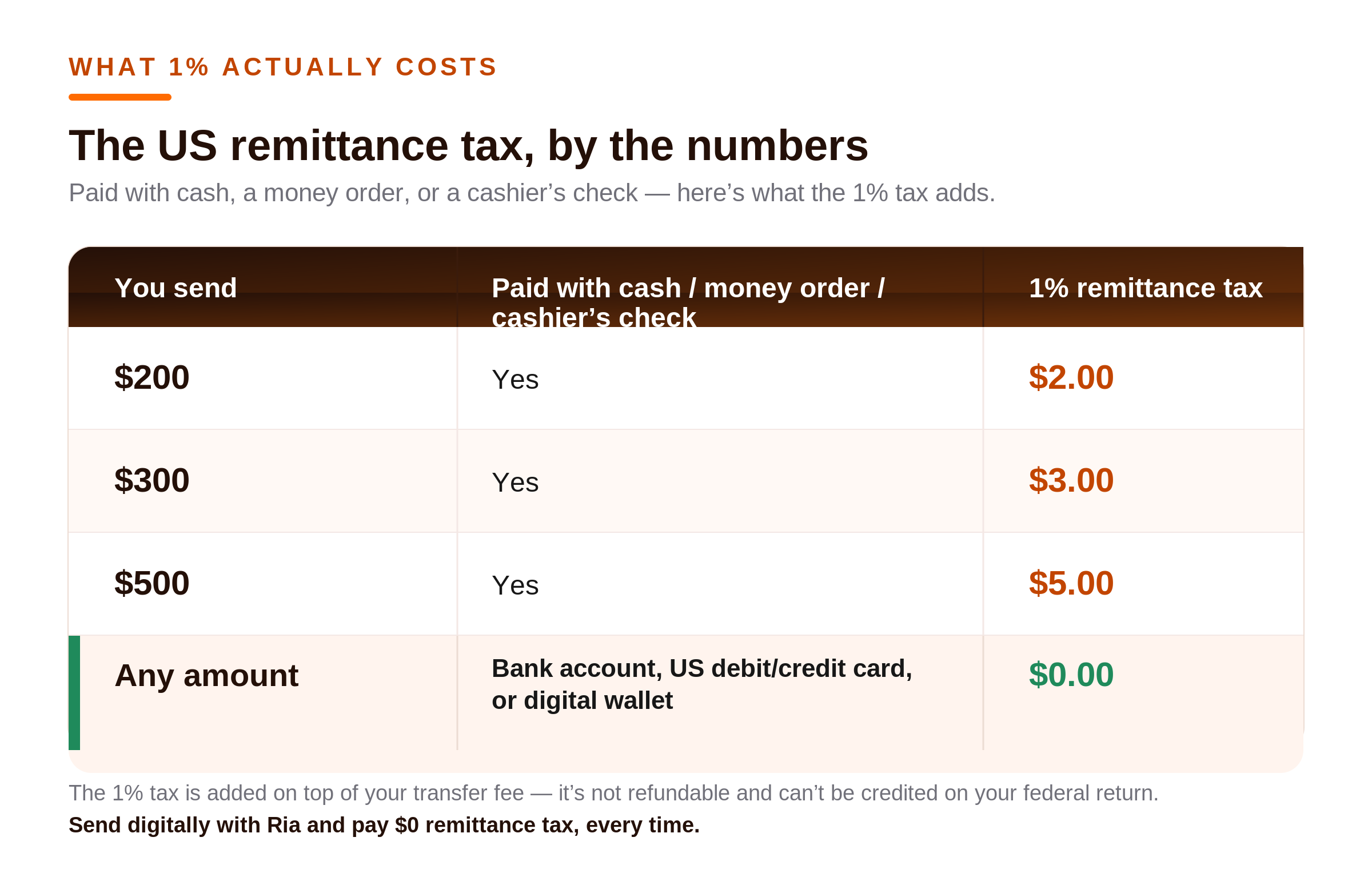
A few things worth knowing:
The 1% tax is separate from your transfer fee, it's added on top, not instead of it.
It's also not refundable, and you can't claim it back as a credit on your federal tax return.
If you pay in cash, it's simply part of the cost of sending money that way now.
Six months in: what's actually happened
A few things have become clearer since January:
The rules are still being finalized. The Treasury Department and the IRS issued proposed regulations on April 10, 2026, to clarify exactly how the tax applies. The public comment period on those proposed rules closed June 12, 2026. As of this writing, the regulations are still proposed, not final, so some details could still change before they're locked in.
In October 2025, the IRS issued penalty relief (Notice 2025-55) for remittance providers that made deposit errors during the tax's first three quarters.
Cash-funded transfers have gotten measurably more expensive. Transfers funded digitally by bank account, debit card, or credit card haven't changed at all.
Who has to pay it
The tax is based on how you fund your transfer, not on your immigration status or citizenship.
Anyone, a US citizen, a green card holder, a visa holder, or someone without legal status, pays the same 1% if they fund a remittance with cash, a money order, or a cashier's check.
The only way to not pay the tax is to fund your transfer digitally.

How to make a digital money transfer with Ria
Download the Ria Money Transfer app or visit our website.
Create an account for free.
Add your payment method (bank account, debit, or credit card).
Choose your destination and delivery method (bank deposit, mobile wallet, or cash pickup).
Confirm and send.
Your recipient gets the money, often in minutes, and you can keep them in the loop with Ria’s track a transfer tool.
Frequently asked questions
What is the 1% remittance tax?
It's a federal tax created by the One Big Beautiful Bill Act that applies to certain international money transfers when they're funded with cash, a money order, or a cashier's check.
Does the tax apply to all transfers?
No. It only applies to transfers funded with cash or a cash-like instrument. Transfers funded through a bank account, a US debit or credit card, or a digital wallet are exempt.
Is the remittance tax rate final, or could it still change?
The 1% rate is set in law, but the detailed rules for how it's applied are still being finalized. Treasury and the IRS proposed regulations in April 2026, and the public comment period closed in June 2026. The final version of those rules hasn't been published yet.
Can I get the tax refunded or credited on my tax return?
No. The remittance tax is not refundable, and it can't be claimed as a credit or deduction on your federal tax return.
Why choose digital transfers?
Digital transfers are the only way to avoid this tax entirely. You can send from home using your phone or computer, with no lines and no paperwork.
Is Ria compliant with the new regulation?
Yes. Ria operates in full compliance with US financial regulations and clearly shows any applicable taxes and fees before you confirm a transfer.
Send money with Ria
Send money to your loved ones across the world. Cashless, fast, and secure. Start your transfer today.
About the author

Gabriela Solis
Gabriela Solis is Ria's Senior Content Writer. Located in Querétaro, México, she focuses on telling stories that show the myriad human faces of remittances.
Related posts

Venezuela Earthquake (2026): How to Help, Find Relief Resources, and Send Money
Many of our customers have loved ones in Venezuela. If that’s you, we’re thinking of you. Here’s what you need to know: Information is based on updates from USGS, UN OCHA, IFRC, and other humanitarian organizations. Details may change as emergency response efforts continue. On the evening of June 24, two powerful earthquakes struck Venezuela []
The Currency of Caring: The Human Side of Remittances
Every year on June 16th, the world observes International Day of Family Remittances. On that date, we recognize the millions of migrants who send money back home to support their loved ones, helping build a better future for countless households across the globe. Although there is a lot of data about the financial impact and []

How Mobile Wallets Are Expanding Financial Inclusion in Emerging Markets
In the last decade, there has been a surge of applications and services that enable people to store, send, and receive money without needing a traditional bank account. Digital financial services such as mobile wallets have emerged as an accessible option for millions of unbanked people. These alternatives have become the first point of access []
Sadio Mané and Ria: Empowering the Global Diaspora
Sadio Mané is considered one of the best and most recognizable African footballers of all time. But the Senegalese striker is more than just a global football icon: throughout his career, he’s reinvested his earnings back into his community, bridging the gap between football, migration and financial empowerment. That’s why at Ria we are extremely []