)
)
Cyber Security Awareness Month
)
)
While we’ve been busy worrying about whether robots will take over the world, cybersecurity breaches are expected to cost trillions in damages by 2021.
The National Cyber Security Awareness Month (NCSAM) was instituted in 2004 by the U.S. Department of Homeland Security and the National Cyber Security Alliance to “ensure that every individual stays safe and secure online.”
Today, the European Union Agency for Network and Information Security (ENISA) oversees a similar event in Europe, with Norway organizing its own through NorSIS (Norsk senter for informasjonssikring, “The Norwegian Center for Information Security” in English).
But what is cyber security?
Cisco defines cybersecurity as the practice of protecting systems, networks, and programs from digital attacks. Meanwhile, the Digital Guardian defines it as a body of technologies, processes, and practices designed to protect networks, devices, programs, and data from attack, damage or unauthorized access.
We’ll just call it self-defense for the digital world.
And what are the main objectives of cyber security?
Dedicating a whole month to cybersecurity might sound excessive. But then again, there are more than 4,000 successful cyber-attacks registered every day, with online scams happening at work and at home. If we weigh in the potential risks and damages, the need for constant cybersecurity awareness becomes painfully evident.
The main goal of cyber security, or information technology security, is to protect computers, systems and networks from attacks and attempts at stealing data or information. Cyber security initiatives also aim to safeguard systems or networks from damage or interruptions in their services, which could be inflicted by attackers with various (and malicious) objectives.
And since our everyday lives are more and more reliant on technology, online platforms, mobile devices and digital services, cybersecurity will keep growing ever more critical. For instance, new mobile technologies like 5G, which promise to increase connectivity between devices, call for an even more robust cybersecurity strategy.
When is National Cyber Security Awareness Month?
Cybersecurity Awareness Month is celebrated every October, on to its 17th edition this 2020. Since its establishment many years ago, NCSAM has been providing toolkits and training to teach the public how to defend themselves against cyber-attacks.
Many themes have been addressed at previous editions of NCSAM. In 2018, for instance, Cybersecurity Awareness Month emphasized cybersecurity as a shared responsibility, for which Homeland Security highlighted four key points, as seen below:
Strengthen cybersecurity ecosystems;
Tackle cross-cutting, cross-sector crisis as a team;
Increase and strengthen cybersecurity workforce across all sectors;
Secure critical infrastructure.
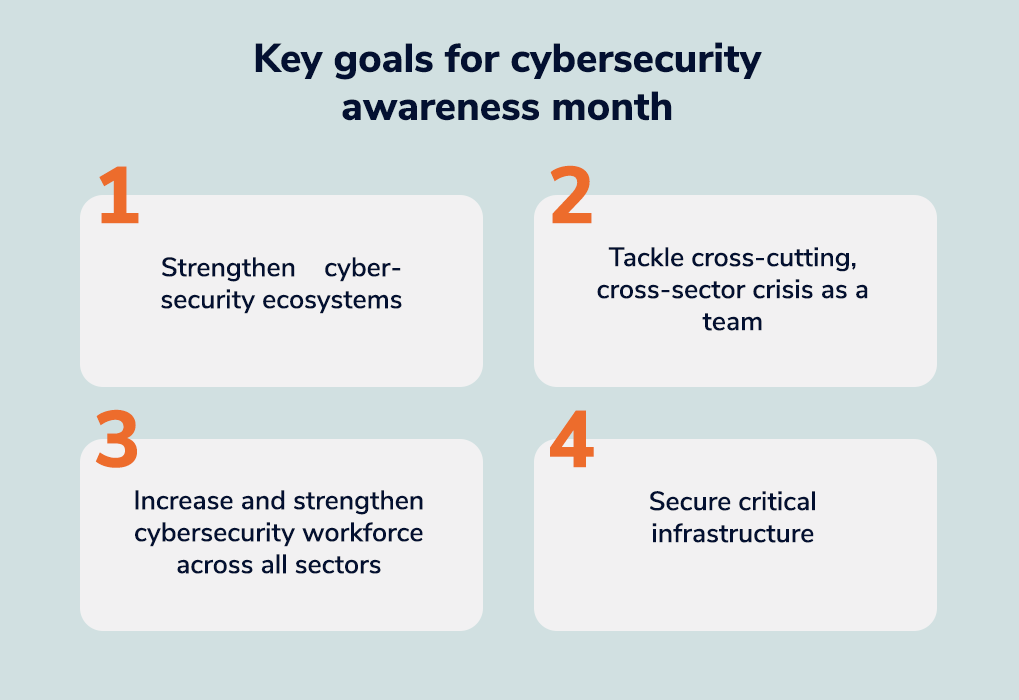
The key points of NCSAM 2018.
The current edition of NCSAM’s focus is “If You Connect It, Protect It.” The topics to be promoted along the four weeks of October are related to establishing cybersecure environments for both personal and work devices. Safeguarding healthcare devices connected to the internet is another hot topic, as is the future of connected devices (as we discussed above regarding 5G).
Types of cyber-attacks
Digital attacks come in all shapes and sizes, targeting anything from computers to networks and having a wide variety of goals behind them. Here is a list of the most common forms of cyberattacks:
Ransomware: sometimes, a malicious software called ransomware can kidnap your files and hold them hostage in exchange for money. However, nothing guarantees they will restore the data after payment. Other times, the software might have a more general target in mind. Malware, on the other hand, will try to gain access to your accounts or damage your computer.
Phishing: the most common type of cyberattack. Have you ever received an email from a seemingly reputable source, only to find there’s something… fishy about the address? Phishing emails are an attempt to steal sensitive information, be it your credit card or login. Then again, there’s a specific, and more dangerous, type of phishing attack called “spear phishing.” In this type of attack, the email and its contents appear to be completely legitimate, being crafted specially for the recipient.
Social engineering: This threat utilizes ransomware or malware, but takes it a step further by tricking its victim into revealing sensitive information, which is then be used for nefarious purposes.
But don’t worry! The good news is that we can avoid many of these attacks by simply being aware of them. That’s NCSAM’s mission, to raise awareness about cyberattacks so you can learn to recognize and avoid them.
The overarching message is that, when it comes to cybercrime, we stand united and fall divided. To emerge victorious, we must prevent breaches at all levels. In the 21st century, we all have to work with the goal of cybersecurity in mind.
About the author

Gabrielle van Welie
Gabrielle van Welie is Ria's Global Content Manager. Originally from Dominican Republic, she specializes in the cultural impact of remittances and migration across the globe.
Related posts

What is Bre-B and how does it work?
Bre-B is Colombia's instant payment system. Learn how llaves work, what Bre-B costs, its transfer limits, and how to send money to a Bre-B key from abroad with Ria.

How Mobile Wallets Are Expanding Financial Inclusion in Emerging Markets
In the last decade, there has been a surge of applications and services that enable people to store, send, and receive money without needing a traditional bank account. Digital financial services such as mobile wallets have emerged as an accessible option for millions of unbanked people. These alternatives have become the first point of access []
What is Stablecoin? A Simple Guide to Understanding How it Works
Stablecoins have become increasingly popular. It’s the new hot topic, especially for cross-border transactions, as this technology it has been changing the way money moves. In this post, we’ll help you understand the basics about this type of cryptocurrency. We’ll also dive into the opportunities and challenges that it brings to the money transfer industry []
How to Monetize Your Platform with Embedded Money Transfer Services
Key Takeaways ▪ Embedded finance allows platforms to offer financial services natively, boosting revenue and user retention. ▪ Integrated Money Transfers enable SaaS, fintechs, and marketplaces to integrate remittance features seamlessly. ▪ Ria Money Transfer offers a scalable, secure, and global API solution for platforms targeting international or migrant users. ▪ Monetizing with remittance-as-a-feature is an evergreen strategy for platforms []