)
)
A Brief History of Migration and Remittances in Italy
)
)
Italy is a European country situated along the Mediterranean Sea. The total population of Italy is around 60.4 million people, and, as a central geographic location in Europe, the country is home to a rich myriad of cultures.
Millions of people move to Italy every year in search of a better life. They make their journeys to earn money abroad and send back home to their loved ones through remittances. Here, we explore the key migration trends in Italy and their relationship with remittance behaviors.
A (Very) Brief History of Italy
Formed by a continental part (the famous “boot”) and surrounded by many islands, Italy is the third country in the European Union in terms of population (approximately 60 million inhabitants) and shares land borders with countries such as Austria, Switzerland and France. Due to this configuration, Italy has been inhabited by many different peoples through the ages, which led to the establishment of various tribes and settlements. The most famous of these were the Romans, whose kingdom became an empire and a republic, going on to conquer large parts of Europe, Asia, and North Africa.
Through the Middle Ages, the Italian city-states became powerful and prosperous, opening the way to the Renaissance and to cultural and economic development. With this, Italy has evolved into an incredibly enticing country. As a result, Italy’s economy attracts many migrants looking for a better life.
Immigration in Italy: newcomers to Italian soil
According to the United Nations Department of Economic and Social Affairs (UN DESA), around 6.3 million international migrants live in Italy. That’s approximately 10.4% of the population of Italy.
From 1990 to 2019, Italy’s immigration rate increased, with a significant spike occurring between 2000 and 2010. During this period, the immigration rate increased from 3.7% to 9.8%, which later stabilized to the current 10.4% recorded in 2019.
The three most significant immigrant groups reported to be living in Italy by 2019* were:
Romanians: 1.1 million
Albanians: 475.2 thousand
Moroccans: 450.6 thousand
A recent study from the IOM (International Organization for Migration) found Moroccans and Chinese to be two of the largest entrepreneurial immigrant communities in the country, therefore contributing to Italy’s economy and its GDP. Other top countries of origin of migrant entrepreneurs recorded include Romania, Albania, Switzerland, and Bangladesh.
Good to know:
Lombardia hosts Italy’s largest share of immigrants and is the origin of the most remittance outflows, followed by Lazio.*
Around half of all companies in Italy set up by immigrants are registered in four main regions: Lombardi, Lazio, Tuscany, and Emelia‡.
Lazio (Central Italy) and Campania (Southern Italy) are the most populated cities in Italy†.
Rome, Milan, and Naples are the largest cities in Italy†.
Source: *World Bank ‡IOM (International Organization for Migration) †UN DESA 2019
Emigration from Italy: Italian nationals moving abroad
Since the late 19th century, Argentina has been a top destination for the Italian diaspora. As recently as 2018, the MAECI (Italian Ministry of Foreign Affairs and International Cooperation) recorded that around 1 million Italians were living in the South American country. With an estimate of 5 million Italians living abroad, the number is equivalent to 1/5th of all the population of Italians residing in other countries.
Germany and Switzerland are the next most popular destinations for Italian migrants. They host around 807,000 and 640,000 Italian emigrants respectively.
Good to know:
More than half of the Italian diaspora (54%) has moved to a European country.
Half of Italy’s emigrant stock (50.1%) are from southern Italy, including Sicily.
Just over one-third of Italian emigrants (34.8%) are from northern Italy, including Lombardi and Piedmont.
Just 15.6% of Italian emigrants are from the central regions, including Latium and Rome.
Source: Register of Italians Residing Abroad (AIRE)
Emigrants and immigrants in Italy, 2017
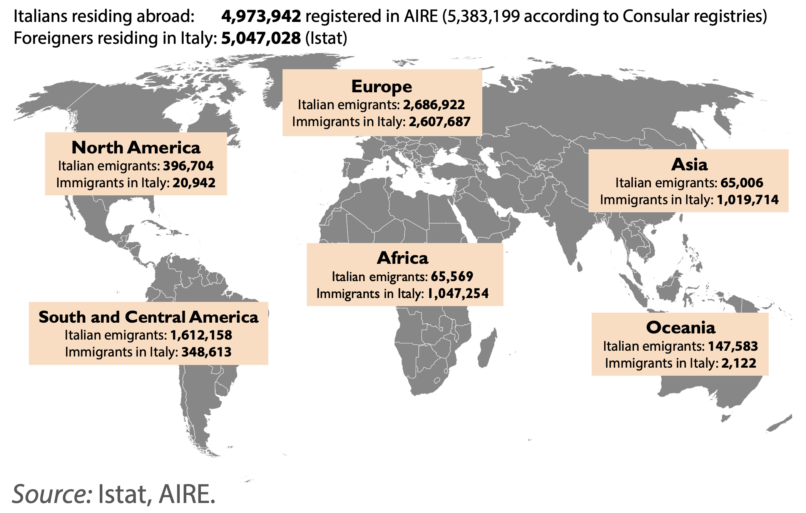
As seen below, in 2017, 4,973,942 Italians registered in AIRE (5,383,199 according to Consular registries) resided abroad, while 5,047,028 foreigners resided in Italy:
Source: IOM
Remittances to and from Italy
The World Bank highlights money transfers as a tool for Italy’s financial development, economic growth, and poverty alleviation. Remittances help the economy of the host country, as well as the receiving households. For the latter, it serves as a lifeline to cover basic needs such as food, housing, clothing, and warmth.
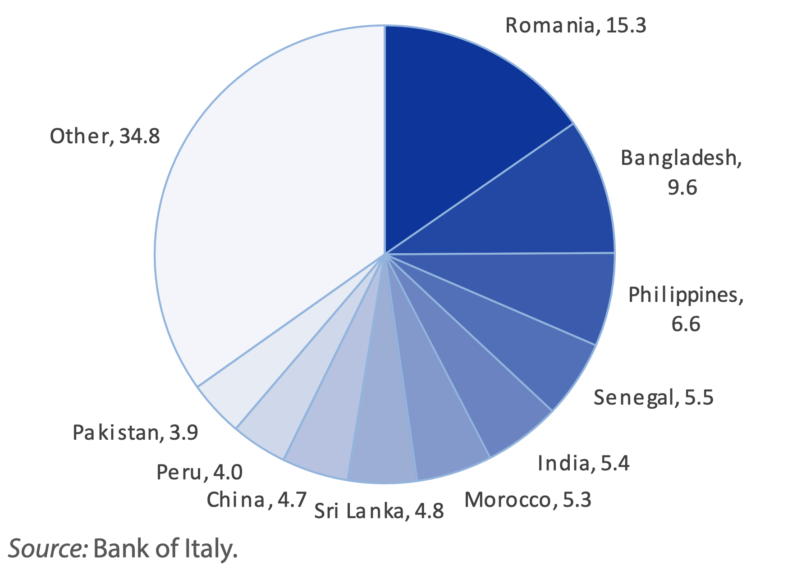
To have a clearer picture of the influence of remittances in Italy’s GDP, let’s look at some numbers. In 2019, Italy received an estimate of US$10.4 billion in remittances. Historically, around half of remitters in Italy (48%) originate mainly from Lombardy, Lazio, and Tuscany. When it comes to remittance outflows, money transfer destinations correlate with the diaspora populations living in Italy. Below are the top 10 receiving countries of remittances from Italy as recorded by the Bank of Italy: Romania, Bangladesh, Philippines, Senegal, India, Morocco, Sri Lanka, China, Peru and Pakistan.
Accessed through IOM.
About the author

Gabrielle van Welie
Gabrielle van Welie is Ria's Global Content Manager. Originally from Dominican Republic, she specializes in the cultural impact of remittances and migration across the globe.
Related posts

How to Build Credit in the US as an Immigrant
Landlords, lenders, and even phone carriers check your credit, and having none can feel like having bad credit. Here's how to build a US credit file from zero, safely.

How to Open a US Bank Account Without an SSN
Here's what you actually need to open a US bank account as an immigrant, and how to avoid the most common reasons applications get turned down.

ITIN vs SSN: What's the Difference and Which Do You Need?
An ITIN and an SSN aren't interchangeable, even though both let you file US taxes. Here's what separates them and which one applies to you.

What Is an ITIN and Do You Need One?
An ITIN lets you file US taxes and open many bank accounts without a Social Security number. Here's who needs one, what it does, and what it costs.