)
)
Top 5 countries most dependent on remittances
)
)
An estimated $574 billion was sent by migrants to their home countries in 2016. In some cases, these billions in cash inflows – called remittances – can make up more than 25 percent of the Gross Domestic Product (GDP) in some developing countries. Regular remittances can contribute to increased investment in health, education, small businesses, savings and other investments. The impact of remittances on a country’s economy, however, does not always depend on the amount of the remittances received, but the size of the economy. According to the World Bank, in 2016 India received the most remittances with $62.7 billion, followed by China with $61 billion. Nevertheless, the billions that India received were equal to just 2.8 percent of their GDP, which pales in comparison to a $2.3 trillion economy.
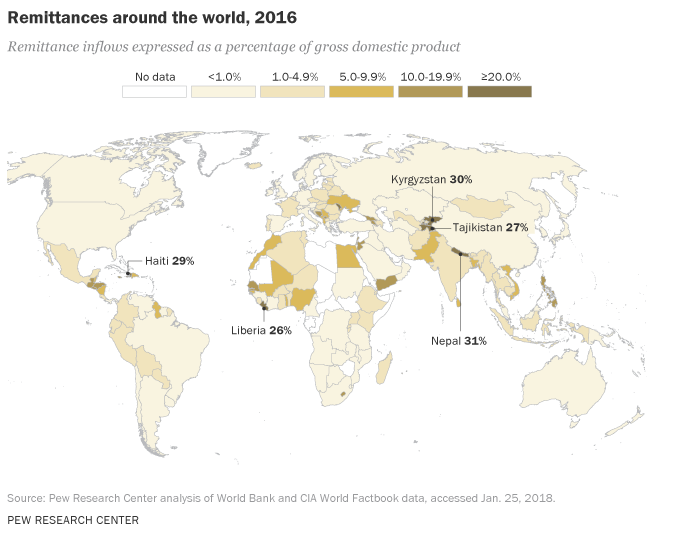
An analysis by Pew Research names Nepal, at 31%, as the country most dependent on remittances in terms of GDP.
The countries where remittances have major economic consequences are usually smaller economies with somewhat large diasporas. In these cases, remittances from citizens abroad have a bigger impact on growth as a stable inflow of cash which is often more than the amount of Official Development Aid (ODA) and external investment.
Top 5 Most Dependent Countries
So which countries are impacted the most? According to Pew Research Center, remittances in the following five countries are equivalent to a quarter or more of all economic output, as measured by GDP.
1. Nepal is the country most reliant on remittances. In 2016 it received an estimated $6.6 billion, which was equivalent to 31 percent of its GDP, according to an analysis of World Bank data.[1] The biggest source countries of remittances to Nepal were Qatar, Saudi Arabia, India and the United Arab Emirates.
An estimated one-quarter of Nepalese people currently live below the poverty line, making remittances a fundamental part of their economy.

Nepal, located in the Himalayas, is the country most dependent on remittances, with these inflows being equivalent to 31.3% of their GDP.
2. Kyrgyzstan with a population of slightly over 6 million, received nearly $2 billion in remittances in 2016, which was equivalent to 30 percent of their GDP. Their economy is primarily dominated by mining and agriculture and also heavily dependent on remittances from citizens working abroad. Remittances from Kyrgyz migrant workers, predominantly in Russia and Kazakhstan, are equivalent to over one-quarter of Kyrgyzstan’s GDP.
3. Tajikistan with an estimated population of 8.7 million people,has one of the lowest per capita GDPs among the 15 countries of the former Soviet Republic. Their GDP per capita is under $400, making it one of the countries from Central Asia to receive more aid from the European Union. Like Kyrgyzstan, it has many citizens working abroad and received $1.9 billion equivalent to 27 percent of their GDP in 2016.
4. Liberia in Africa with a population of about 4.6 million also relies upon foreign assistance and remittances from the diaspora. In 2016 they received $549 million in remittances equivalent to 26 percent of their GDP, making them the fourth country most dependent on remittances.
5. Haiti a country plagued by natural disasters in recent times is the poorest country in the Western Hemisphere. Haiti depends on remittances as the primary source of foreign exchange.
In 2016, Haiti received about $2.4 billion in remittances, equivalent to 29 percent of their GDP – practically double the combined value of its exports and foreign direct investment. [2]
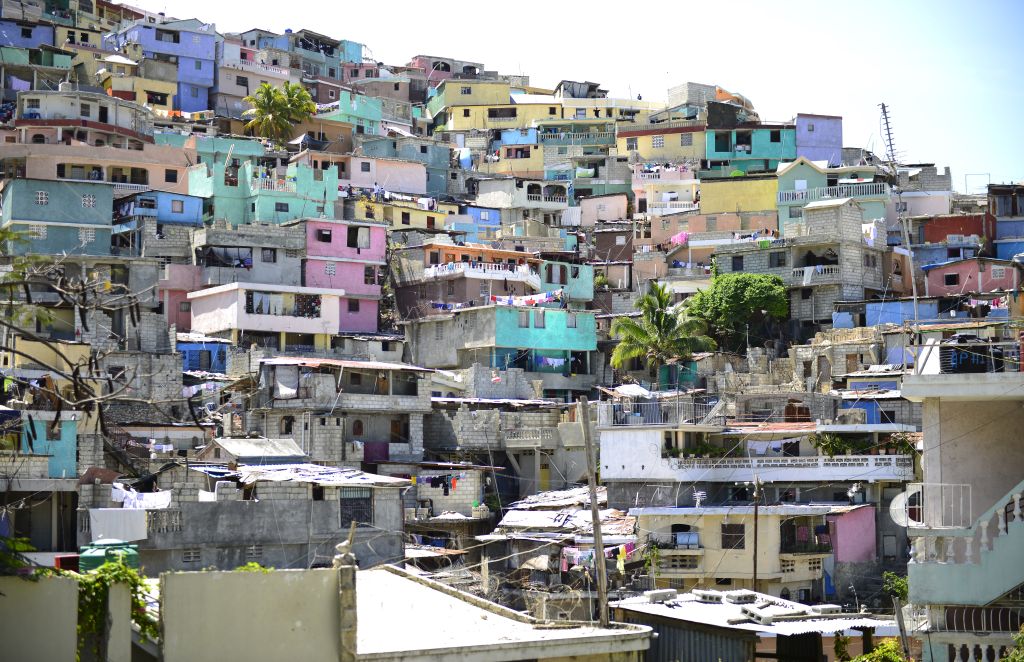
Haiti received around $2.4 billion in remittances in 2016, representing 29 percent of their GDP.
For these five countries, remittances from abroad are equivalent to a quarter or more of all economic output, as measured by GDP. In nine other countries, they were equivalent to between 15-25 percent of GDP.
After a brief slowing period, there is a general upward trend again for remittances, which are expected to reach $466 billion by the end of 2018 for developing countries. Global remittances, including those to developed/high-income countries, may also rise to $616 billion in 2018.
At Ria, we recognise that remittances are paramount in the lives of many and we’re proud to be part of an industry that provides opportunities, especially for those in developing economies. That’s why we will always offer high-quality, affordable, money transfer services to all our customers, so they can continue to improve the lives of their loved ones back home.
[1] Pew Research Center, retrieved March 2018 http://www.pewresearch.org/fact-tank/2018/01/29/remittances-from-abroad-are-major-economic-assets-for-some-developing-countries/
[2] CIA Fact Book Haiti, retrieved February 2018 https://www.cia.gov/library/publications/resources/the-world-factbook/geos/kg.html
About the author
Alaine Anderson
Related posts

What is Bre-B and how does it work?
Bre-B is Colombia's instant payment system. Learn how llaves work, what Bre-B costs, its transfer limits, and how to send money to a Bre-B key from abroad with Ria.

The Money That Moves the World Is Personal
200 million people built one of the world's most powerful financial systems, but few call it that.
Colombia Earthquake (2026): How to Help, Find Relief Resources, and Send Money
On the morning of August 10th, a 7.4-magnitude earthquake struck western Colombia. Ria is waiving transfer fees to Colombia through August 16.

Venezuela Earthquake (2026): How to Help, Find Relief Resources, and Send Money
Many of our customers have loved ones in Venezuela. If that's you, we're thinking of you. Here's what you need to know: Information is based on updates from USGS, UN OCHA, IFRC, and other humanitarian organizations. Details may change as emergency response efforts continue. On the evening of June 24, two powerful earthquakes struck Venezuela.